

 Sample Submission Guidelines

When Should Organoids Be Sequenced? Baseline, Post-Expansion, Post-Thaw, and Post-Treatment QC
Meta Intent: A practical framework for deciding when organoid models need DNA or RNA sequencing at baseline, after expansion, following cryopreservation and thawing, and before or after experimental treatment.
Organoid sequencing is often planned as a one-time characterization task. That approach is convenient, but it does not answer the question that determines whether later data can be trusted: does the model still represent the intended biology at the moment a study is run? A culture can look healthy after expansion, recover from freezing, or remain viable during a compound experiment while its cell composition, transcriptional state, or clonal balance changes. Sequencing is most useful when it resolves a defined release decision rather than when it is scheduled simply because another passage has been reached.
This guide uses four practical checkpoints: baseline, post-expansion, post-thaw, and post-treatment. Each checkpoint has a different question, comparator, and minimum evidence tier. The goal is not to prescribe one universal passage number or a single high-cost assay. It is to help teams build a lean sequence of molecular checks that protects scarce organoid material and makes later results interpretable.
Sequencing Timing Is an Experimental Design Variable
The timing of molecular QC changes what a sequencing result means. An early sample can define identity and the starting molecular landscape. A sample taken after expansion can show whether the culture remains suitable for a planned screen. A post-thaw sample can distinguish recovery failure from a stable shift. A treatment-series sample can reveal a response only if it is paired with the right time-matched control. Treating all of these samples as interchangeable creates avoidable ambiguity.
The practical alternative is a decision-triggered schedule. Before collecting material, write one sentence that states the release question. Examples include: "Does the expanded line retain the baseline variant set needed for this study?" "Has the thawed working vial recovered its expected transcriptional state before a screening run?" or "Does exposure alter gene expression before survival selection changes the population?" Questions written this way determine the minimum assay, the necessary comparator, and the action that follows a PASS, HOLD, or ESCALATE result.
This timing framework complements, rather than replaces, a broader sequencing-based framework for organoid model qualification. Qualification asks whether a model has enough evidence to enter a research workflow. Timing QC asks when that evidence needs to be refreshed as the workflow progresses.
 Figure 1: A four-checkpoint organoid sequencing timeline links baseline, expansion, thaw, and treatment samples to the decisions they support.
Do Not Sequence Every Passage: Use Planned and Event-Triggered Checkpoints
Passage number matters, but it is not a complete biological clock. Two organoid lines at the same passage can have experienced different culture durations, split ratios, matrix lots, recovery periods, medium changes, and selection pressures. Conversely, a stable model may not need broad sequencing at every passage. The useful principle is to define planned checkpoints and add a molecular check when a meaningful process event occurs.
Planned checkpoints
A minimal longitudinal plan normally includes an early baseline reference, a checkpoint before a costly downstream study or bank release, a recovered post-thaw checkpoint for working stocks, and paired sampling around a treatment experiment. The exact intervals should be validated for the organoid type and intended use. Protocols that use fixed intervals such as P5, P10, and P20 provide a useful starting example for identity monitoring, but they are not a universal molecular stability standard.
Event-triggered checkpoints
Sequence sooner when a culture changes in a way that could alter interpretation. Relevant triggers include a sustained shift in growth rate, altered architecture, a new matrix or medium lot, a different dissociation approach, scale-up to automated handling, a prolonged recovery after thawing, or emergence of an unexpected survivor population after treatment. These events should be recorded with passage number and cumulative culture time. A well-documented organoid model development workflow makes it possible to link a later molecular discrepancy to a specific process change rather than treating it as unexplained drift.
Before ordering sequencing, rule out simple causes that sequencing cannot efficiently solve. A failed growth restart may first require viability assessment, microscopy, contamination testing, or review of seeding density and matrix handling. A suspected sample mix-up may first require an identity assay. Molecular profiling should answer the residual biological uncertainty after those rapid checks are complete.
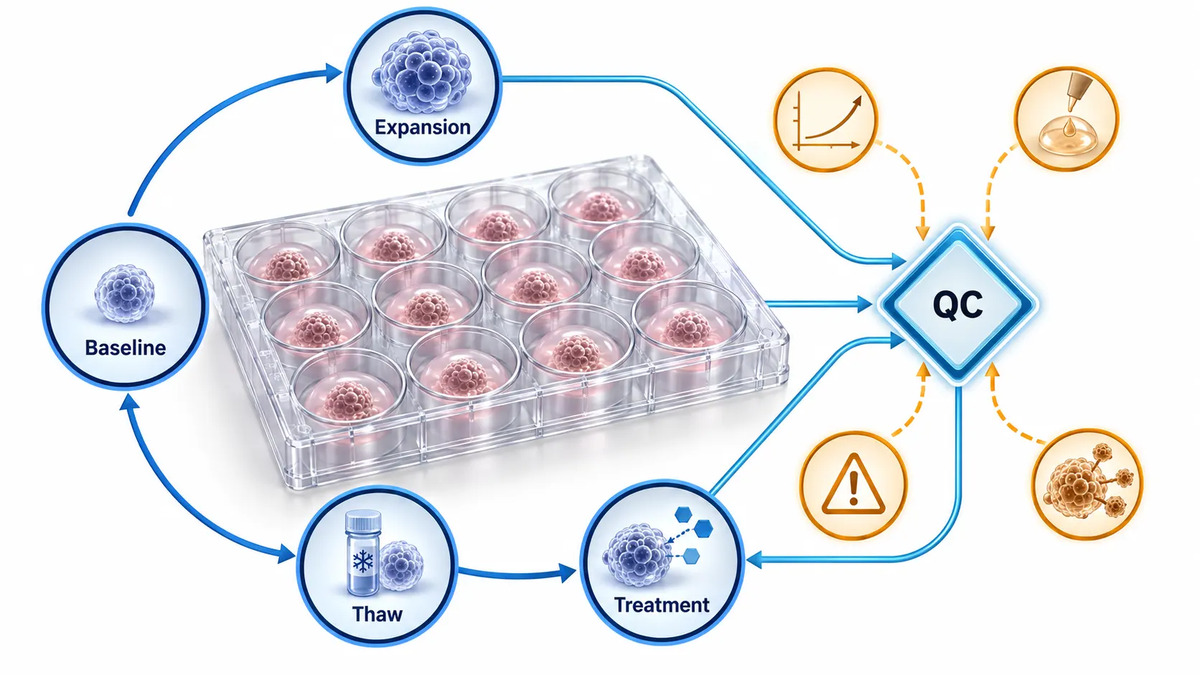 Figure 2: Planned quality-control checkpoints are supplemented by event-triggered sequencing after culture, recovery, or treatment changes that can alter interpretation.
Baseline Sequencing: Create a Reference Before the Model Changes
Baseline is not necessarily the first day that cells enter a three-dimensional culture. An immediately post-isolation sample can be stressed, heterogeneous, and too limited for the planned assay. A practical baseline is the earliest point at which the model has passed identity and contamination checks, shows reproducible growth, and can yield an aliquot without compromising the bank or the planned experiment. That sample becomes the reference against which later checkpoints are interpreted.
Define the baseline question before choosing the assay
DNA and RNA address different baseline questions. DNA-level evidence is useful when the project needs to confirm known variants, broad copy-number landmarks, or sample identity. Where the source tissue has well-supported molecular anchors, a focused targeted region sequencing design may answer the question with less material than a broad discovery assay. If the intended use requires a wider mutational and copy-number context, whole exome sequencing can establish a richer reference. The key is to decide in advance which features must remain trackable later.
RNA profiling is useful when the baseline question concerns lineage programs, target expression, state composition, or the expression context that will frame a later perturbation. A standard RNA-Seq dataset can provide a reproducible bulk reference when the model is sufficiently homogeneous for the stated question. When a bulk profile could conceal a composition shift, single-cell RNA sequencing may be the appropriate escalation, particularly for complex tumor-derived cultures or mixed differentiation systems.
Preserve a reference bundle, not a single file
Each baseline checkpoint should preserve more than a sequencing output. Archive DNA or a cell pellet, RNA where feasible, representative morphology images, the passage and freeze–thaw history, and the relevant source-tissue or normal-comparator information. A small reference bundle is more valuable than an isolated report because it lets future investigators decide whether a difference reflects biology, handling, or an analytical batch effect. For projects that need a broader source-to-model comparison, use the dedicated multi-omics fidelity framework for patient-derived organoids rather than overloading the baseline checkpoint with every possible claim.
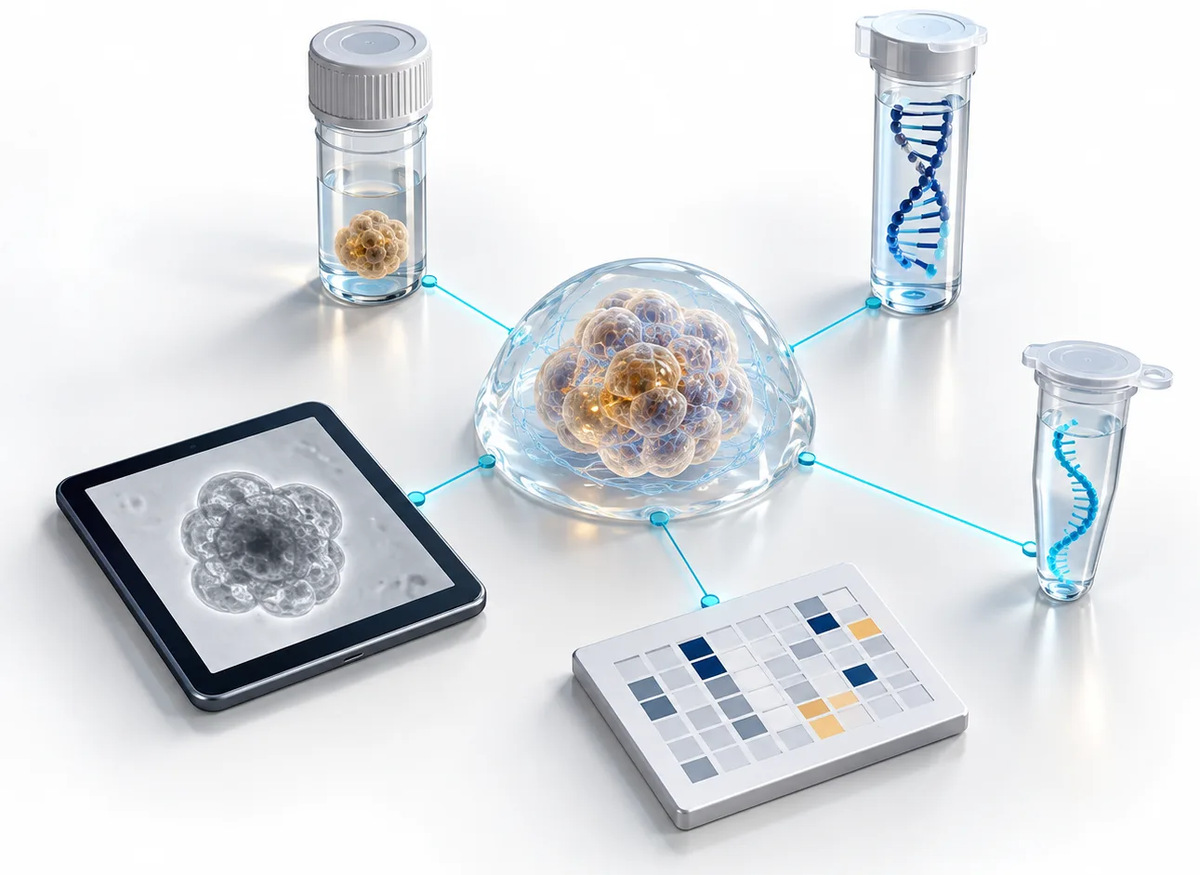 Figure 3: A baseline molecular reference bundle combines DNA, RNA, archived material, morphology, and culture metadata for longitudinal comparison.
Post-Expansion Sequencing: Confirm Fitness Before High-Value Work
Expansion creates enough material for a bank, multiwell screen, or deeper molecular study. It also creates the opportunity for selection. The post-expansion checkpoint should be placed immediately before an irreversible or resource-intensive activity: laying down a master or working bank, distributing a line, starting a large experimental series, or submitting material for a more expensive multi-omics program. The objective is not to demonstrate that no difference has occurred. It is to determine whether any difference changes the model's fitness for the intended use.
Start with the smallest adequate evidence tier
For a line with known baseline anchors, begin with identity confirmation and the most decision-relevant variants or copy-number regions. A targeted test that confirms expected features may be sufficient to release material for a narrowly defined assay. If those anchors weaken, disappear, or become internally inconsistent, move to a broader DNA assessment and review the culture history before attributing the discrepancy to biological evolution.
RNA is not automatically required after every expansion. Add it when the next study depends on transcriptomic state, target expression, or cell-state composition. For example, a model entering an in vitro response characterization study may need an expression release check, while a line being retained only as a genomic reference may not. An integrated organoid sequencing analysis plan can align DNA, RNA, image, and culture metadata so that the team compares like with like across checkpoints.
Use HOLD when a result is not yet interpretable
A changed variant allele frequency or modest expression difference is not automatically a failure. Read depth, copy-number context, clonal composition, RNA quality, and batch placement can all affect the result. A HOLD action is appropriate when the data are insufficient to distinguish selection from technical variation. The next step may be a repeated extraction, a broader panel, a matched earlier aliquot, or a targeted review of normal-cell overgrowth using the separate tumor-purity framework for organoid cultures.
Post-Thaw QC: Separate Recovery Assessment from Stable-State Sequencing
A thawed organoid is not automatically ready to serve as a transcriptomic reference. Freezing, thawing, matrix re-entry, and early recovery can alter viability, proliferation, morphology, and transient stress programs. Immediate post-thaw checks are therefore essential, but they answer a different question from RNA sequencing after biological recovery.
What to assess immediately after thawing
Immediate QC should focus on recovery capacity: viable material, structural integrity, contamination status, early attachment or matrix re-entry, and whether the culture resumes expected growth. An organoid characterization workflow can combine morphology, selected lineage evidence, and recovery observations before molecular material is committed. If architecture is uncertain, an organoid histology review may provide useful spatial context, but it should not substitute for a defined DNA or RNA comparator.
When to collect recovered-state RNA
For routine working-stock QC, collect RNA after the culture reaches predefined recovery criteria. These criteria should be model-specific and may include viable regrowth, expected morphology, a stable growth trajectory, and completion of the local recovery procedure. Do not prescribe a universal number of days or passages. A line with rapid growth and simple architecture may recover on a different schedule from a slow-growing, complex, or differentiation-sensitive model. When RNA stability is the concern, a targeted organoid RNA stability assessment can help define whether apparent change arises during sample handling or from the recovered biology itself.
If the research question is specifically whether cryopreservation changes the model, use a three-point design: pre-freeze, immediate post-thaw, and recovered post-thaw. This separates transient recovery stress from persistent molecular differences. It also prevents a common interpretation error: treating an early stress signature as evidence that the banked model has permanently changed.
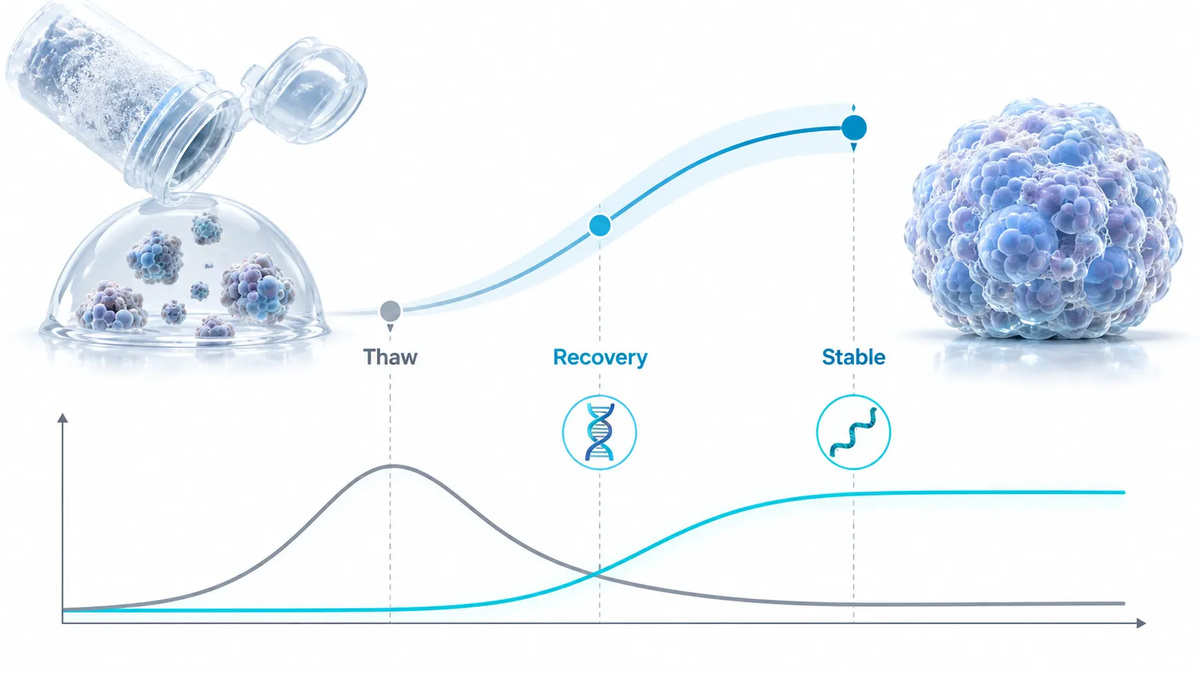 Figure 4: Post-thaw quality control distinguishes immediate recovery checks from sequencing after an organoid reaches a predefined stable recovery state.
Post-Treatment Sequencing: Match the Sampling Window to the Biological Question
Drug exposure does not create one universal "post-treatment" state. Early RNA changes may capture immediate pathway engagement, stress signaling, or cell-cycle effects. Later sampling can reveal adaptation, differentiation changes, or altered cell proportions. Long-term exposure may select surviving clones. A meaningful treatment design therefore begins with the mechanism question, not with a convenient endpoint.
Build a paired design before treatment starts
Organoid harvest is often destructive. A true pretreatment reference should therefore come from a sibling well, a matched split culture, or an aliquot harvested at time zero from the same culture batch. Every treated timepoint needs a vehicle control collected at the same time. Historical baseline material can support interpretation, but it cannot replace an experiment-specific comparator when medium, passage, recovery stage, or library batch differs.
For early signaling questions, collect RNA at a window defined by the expected response and include a time-matched vehicle. For later state questions, add a second or third window that allows the model to adapt. For long exposures, an endpoint DNA comparison may be appropriate if the goal is to identify clonal selection or acquired resistance. Do not use endpoint DNA by default for an acute expression study. The assay should follow the biological claim.
Predefine what a negative result means. If an early RNA sample shows no change while a phenotypic effect is already evident, the next step may be an adjusted RNA window, a viability-normalized dose series, or a cell-composition check—not an automatic conclusion that the treatment has no molecular effect. Conversely, a large late transcriptional difference without a matched viability or morphology record may reflect selective survival rather than pathway modulation. Capturing an untreated sibling, vehicle-treated control, and appropriate harvest window turns those alternatives into testable interpretations.
When a study connects drug exposure with transcriptomic change, an organoid drug transcriptomics workflow can integrate concentration design, matched controls, RNA quality requirements, and differential-expression analysis. For larger in vitro screens, organoid drug screening services can provide a complementary phenotypic layer, but viability and sequencing readouts should remain analytically distinct until the experiment is designed to connect them.
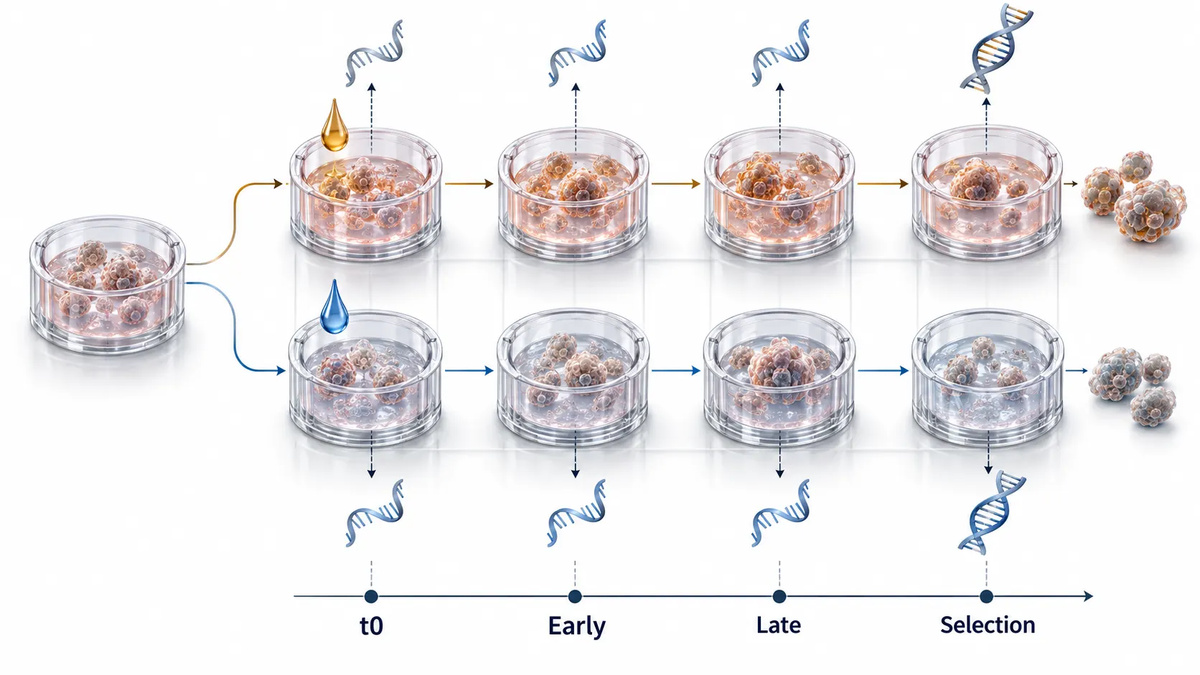 Figure 5: Treatment-aligned organoid sampling uses paired baseline and vehicle controls with early RNA, late RNA, and long-term DNA checkpoints for different questions.
Choose the Assay Tier That Resolves the Decision
Sequencing depth and modality should rise only when the lower tier cannot answer the release question. This keeps QC efficient and reduces the risk of producing broad data without a predefined interpretation path.
| Checkpoint question | Minimum evidence | Required comparator | Escalate when |
|---|---|---|---|
| Is this the intended model? | Identity assay and known DNA anchors | Founding specimen or accepted baseline record | Anchors conflict, source data are incomplete, or sample mix-up is plausible |
| Is the expanded culture still fit for purpose? | Targeted variants, key CNV landmarks, and morphology review | Qualified baseline at comparable passage context | Variant pattern changes, morphology shifts, or the next study depends on state composition |
| Did the working vial recover? | Viability, morphology, contamination testing, and post-recovery identity | Pre-freeze release record and matched recovery window | Recovery is delayed, growth is inconsistent, or cryopreservation impact must be measured |
| What changed after treatment? | Paired, time-matched bulk RNA-seq | Vehicle and baseline controls from the same batch | Bulk data imply composition changes, long-term survival selection, or multi-layer mechanisms |
Broader approaches are valuable when they answer the next question. A multi-omics service can help resolve whether a durable phenotype involves coordinated genomic, transcriptional, or epigenetic changes. It should not be used as a default substitute for a well-designed targeted confirmation. Likewise, the planned article on passage, matrix, and culture-medium effects on organoid drift addresses how process variables can drive change; this article focuses on the timing decision that tells you when to look for it.
Prevent Timepoint–Batch Confounding Before It Reaches Bioinformatics
A longitudinal design fails if every biological timepoint is processed in a separate technical batch. If baseline libraries are prepared in one run and post-treatment libraries in another, observed differences can reflect extraction, library preparation, sequencing, or analysis variation rather than biology. This problem cannot be fully repaired after the fact.
Balance timepoints, controls, and experimental conditions across extraction and library batches whenever possible. Use the same reference genome, processing pipeline, and versioned thresholds across the study. If the project must span multiple batches, include a bridge sample: a retained reference DNA or RNA aliquot that appears in each batch. The bridge sample is a technical anchor, not a biological replicate. Its role is to reveal whether a later batch is compatible with the original baseline.
Batch balance begins on the culture plate, not at the sequencer. Distribute conditions across plate positions, avoid assigning all baseline wells to one plate edge, and record when a batch was split because of handling capacity. When multiple organoid lines are included, do not let line identity become perfectly correlated with extraction day or library lane. Those small allocation choices preserve the possibility of separating line effects, treatment effects, and technical variation during downstream analysis.
Document the information that makes a difference interpretable: sample collection time, passage, culture duration, thaw count, matrix lot, media version, treatment condition, sequencing batch, and analysis pipeline version. This is intentionally narrower than a full biobank governance discussion. For master-stock annotation and release records, link forward to the same-cluster resource on building a research-grade organoid biobank.
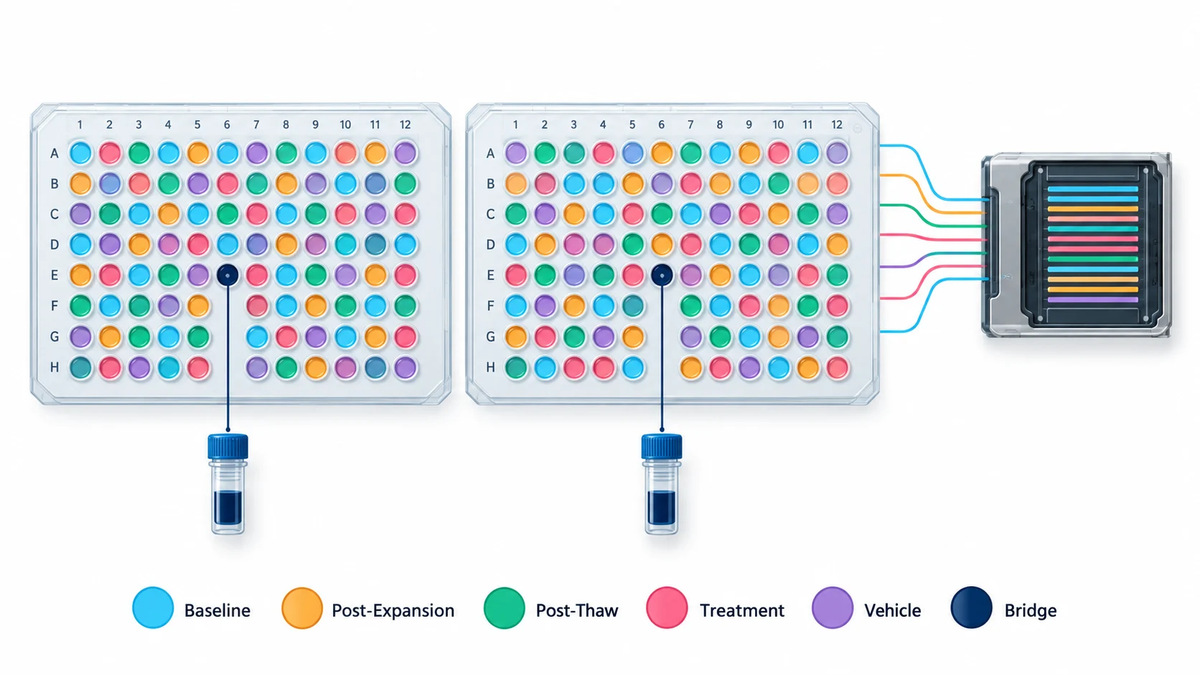 Figure 6: A batch-balanced organoid sequencing layout mixes timepoints and controls while using a bridge sample to reveal technical drift across runs.
Use PASS, HOLD, and ESCALATE Rules Before Data Arrive
Sequencing becomes actionable when the decision rule is written before the data are reviewed. A PASS result means the planned evidence set is consistent with the intended use. A HOLD result means the evidence is incomplete or confounded. ESCALATE means the data indicate a meaningful discrepancy that requires a broader assay, a matched comparator, or a process investigation. A restart or re-derivation decision should be reserved for confirmed identity failure, persistent contamination, or a model that no longer meets its stated research purpose.
Examples of HOLD conditions include low-input extraction, poor RNA integrity, an unmatched control, inconsistent library batch placement, or a single discordant variant without copy-number context. Examples of ESCALATE conditions include loss of several expected molecular anchors, a stable post-thaw phenotype that differs from the pre-freeze reference after recovery, or a treatment endpoint that suggests a large composition shift. The important point is that the action follows the evidence gap. It does not follow a universal threshold borrowed from a different organoid system.
A One-Page Checkpoint Worksheet for Project Teams
Before each sequencing submission, complete the following worksheet. It turns a generic "send the organoids for sequencing" request into a decision-ready project brief.
- Checkpoint: baseline, post-expansion, post-thaw, or post-treatment.
- Decision: the exact PASS, HOLD, or ESCALATE question.
- Comparator: source tissue, early passage, pre-freeze aliquot, sibling well, or time-matched vehicle.
- Minimum assay: identity, targeted DNA, bulk RNA-seq, or a defined alternative.
- Escalation assay: WES, single-cell RNA-seq, multi-omics, or repeat extraction.
- Required metadata: passage, culture duration, thaw history, matrix and medium lot, processing batch, and sample archive location.
- Release action: proceed, hold material, investigate the process record, or re-establish the model.
CD Genomics can align the experimental question with organoid sequencing services, focused DNA or RNA methods, and downstream analysis. The most useful request begins with the checkpoint question and comparator, not only the desired platform.
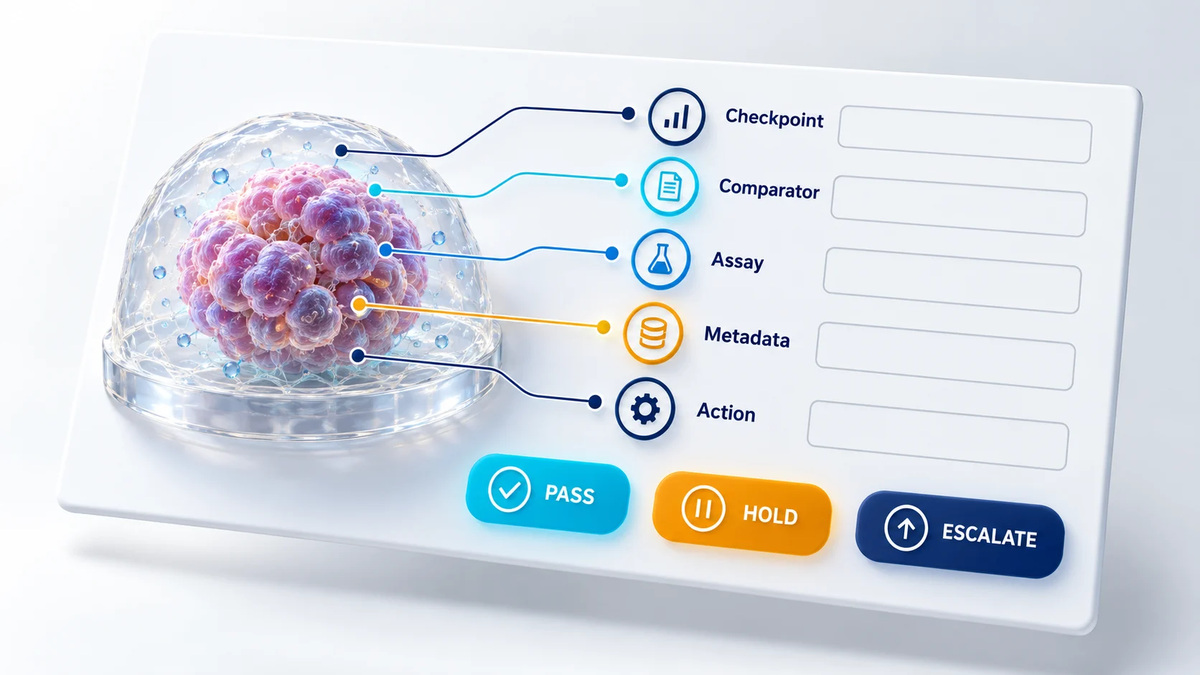 Figure 7: A one-page organoid sequencing worksheet records the checkpoint, comparator, assay tier, metadata, and predefined release action.
Frequently Asked Questions
Should organoids be sequenced at every passage?
No. Use validated planned checkpoints plus event-triggered checks after meaningful process or phenotype changes. Passage number alone is not a sufficient trigger.
Can an immediate post-thaw RNA sample serve as the new baseline?
Usually not for routine QC. It may be useful for a dedicated cryopreservation-impact study, but recovered-state RNA should be collected after predefined recovery criteria are met.
Is an old baseline file enough for a new drug study?
No. Historical baseline material supports context, but a treatment study needs a same-batch pretreatment or time-matched vehicle comparator.
When is WES more useful than a targeted panel?
Use WES when known anchors are insufficient, source information is incomplete, or broader mutational and copy-number context is required. Use a targeted assay when it can answer the release decision directly.
Should long-term drug exposure always include DNA sequencing?
DNA sequencing is most informative when the study concerns clonal selection, resistance, or durable survivor populations. It is not a default substitute for RNA profiling in an acute response experiment.
What if sequencing and morphology disagree?
Do not resolve the conflict by choosing the more convenient result. Place the model on HOLD, verify identity and sample handling, and escalate only after the relevant comparator is available.
Reference:
- Culture-specific transcriptional drifts limit the fidelity of organoid infection models. PLOS Pathogens. 2026.
- A living biobank of matched pairs of patient-derived xenografts and organoids for cancer pharmacology. PLOS ONE. 2023.
- Standardization and quality assessment for human intestinal organoids. Frontiers in Cell and Developmental Biology. 2024.
- Cryopreservation of human cortical organoids using vitrification. Frontiers in Molecular Neuroscience. 2026.
- Comprehensive protocols for culturing and molecular biological analysis of IBD patient-derived colon epithelial organoids. Frontiers in Immunology. 2023.
- Marinucci M, et al. Standardizing Patient-Derived Organoid Generation Workflow to Avoid Microbial Contamination From Colorectal Cancer Tissues. Frontiers in Oncology. 2022. doi:10.3389/fonc.2021.781833.
For research use only. Not for use in diagnostic procedures, clinical decision-making, patient stratification, therapeutic selection, or clinical trials.