

 Sample Submission Guidelines

Passage, Matrix, and Culture-Medium Effects on Organoid Genomic and Transcriptomic Drift
Meta Intent: A practical experimental-design guide for distinguishing stable genomic or clonal drift from reversible transcriptomic adaptation caused by passage history, extracellular matrix, and culture-medium variables in organoid models.
Organoid models do not remain biologically static merely because their morphology looks familiar. A line can retain its general architecture while a minority clone expands, a differentiation program shifts, or a medium-dependent state becomes dominant. The difficult part is not noticing that two organoid samples differ. It is deciding whether the difference represents stable selection, a reversible culture response, an altered cell-state mixture, or a technical artifact. Treating every difference as "drift" makes the problem sound simple and makes the conclusion less useful.
This guide focuses on causal attribution. It does not prescribe a universal maximum passage number, because passage number is only a label for a much larger exposure history. Instead, it shows how to build a comparison in which passage, matrix, and medium can be separated before sequencing is used to explain them. That approach extends the broader sequencing-based framework for organoid model qualification: qualification establishes whether a model is fit for a defined study, while drift attribution asks why its molecular state changed over time.
Organoid Drift Is Not a Single Biological Event
"Drift" is often used as a catch-all term, but at least four mechanisms can produce the same first observation: a separation in principal-component space, a different pathway score, or a changed variant allele fraction. Each mechanism calls for a different response.
- Genomic or clonal drift refers to persistent changes in clone frequency, copy-number profile, or acquired variants. It matters because it can change the biological population available for downstream experiments.
- Transcriptomic state drift is a shift in gene expression that can occur without a detectable DNA change. It may be driven by nutrient signals, growth-factor balance, hypoxia, matrix mechanics, dissociation stress, or time since replating.
- Cell-composition drift occurs when the proportion of existing epithelial, stromal, immune, or differentiated populations changes. In bulk RNA-seq, this can resemble a within-cell transcriptional change.
- Technical drift arises from library preparation, operator, sequencing lane, imaging, or batch structure. It can be real in the data while not being real in the culture.
A defensible study begins by naming the competing explanations. For a relatively broad molecular screen, coordinated organoid sequencing services can place DNA and RNA evidence against the same culture history. When a signal may simply reflect a changing mixture of states, single-cell RNA sequencing is a useful escalation rather than an automatic first step.
 Figure 1. Four routes to apparent organoid drift: stable genomic or clonal selection, reversible transcriptomic adaptation, changing cell composition, and technical variation can all produce a molecular difference but require different follow-up evidence.
Passage Number Is a Label, Not a Complete Exposure Metric
Two cultures called "passage 8" may have experienced very different selective conditions. One may have been split gently at a 1:2 ratio every five days. Another may have been fragmented more aggressively, replated at low density, held longer before recovery, and expanded through more population doublings. Reporting the passage number without the process that produced it can hide the variable that actually changed the culture.
Record passage as a compact exposure history: cumulative days in culture; split ratio and target density; dissociation reagent, duration, and shear; size-selection or filtration step; matrix volume and handling temperature; interval from replating to collection; recovery after thaw; and estimated population doublings where feasible. This is not bureaucratic overhead. It makes it possible to distinguish a chronological association from an exposure that could plausibly select cells or reset their state.
In a drift study, compare cultures at a matched biological phase, not merely on the same calendar day. Sampling a newly replated culture in one condition and a mature culture in another is a direct route to an uninterpretable RNA profile. If the project needs an explicit schedule of baseline, post-expansion, post-thaw, and post-treatment collections, use the companion organoid sequencing time-point QC guide to set those collection anchors before running the attribution experiment.
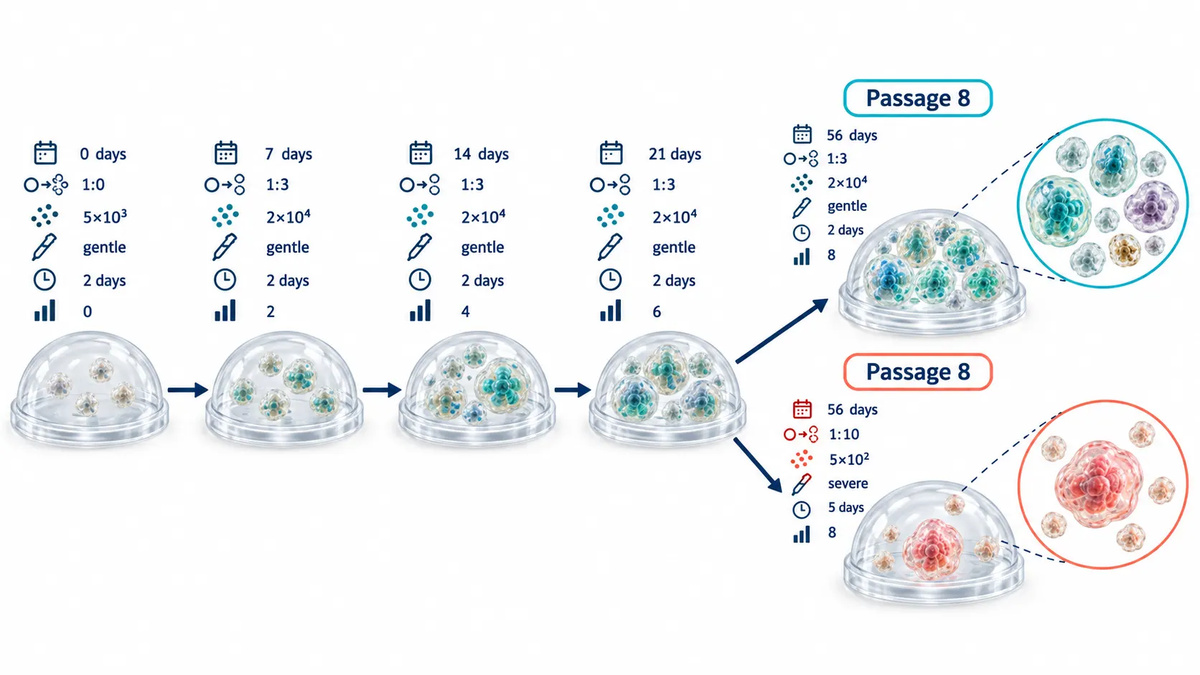 Figure 2. A passage number is an incomplete label: cumulative culture days, split ratio, density, dissociation intensity, recovery interval, and population doublings together define the selective exposure history of an organoid culture.
How Repeated Passaging Can Reshape a Culture
Repeated expansion can alter an organoid culture through selection even when no new mutation is required. Each passaging event creates a bottleneck. Cells that survive dissociation, reform structures efficiently, tolerate lower density, or respond strongly to the available growth factors can become overrepresented. A pre-existing subclone can therefore become visible only after several rounds of expansion. Conversely, a de novo variant may arise and then expand. The distinction matters because a single late-passage sequencing result cannot tell which route occurred.
Use a longitudinal DNA comparison when the question is whether the clone structure has changed. A targeted panel may be enough when a few known loci define the concern. For broader coding-region comparison, organoid whole-exome sequencing can compare matched aliquots across culture history, while CNV sequencing can help test whether larger-scale gains or losses move with the apparent state change. Variant allele frequency must be interpreted in the context of copy number, purity, and cell composition; a changed VAF is evidence to investigate, not a complete explanation by itself.
When cell composition is the main uncertainty, do not relabel normal-cell overgrowth as a generic passage effect. A dedicated purity question needs its own controls and markers. The matrix article on detecting normal-cell overgrowth before sequencing addresses that specific confounder. Here, the key point is narrower: make sure a composition shift is not being mistaken for a stable within-cell response to matrix or medium.
Matrix Effects Extend Beyond Lot-to-Lot Variability
Extracellular matrix is often reduced to a catalogue number and lot. Those details are important, but they are not the whole experimental variable. Matrix composition, protein concentration, stiffness, thickness, polymerization temperature, dome geometry, and the cells' time in contact with the matrix can all change receptor signaling, polarity, growth geometry, oxygen and nutrient gradients, and access to soluble factors. A matrix change can produce a rapid expression shift without any genomic change. It can also create a chronic selection environment that favors one population over another.
Separate acute matrix response from chronic matrix selection. An acute response is most plausibly tested by splitting a common culture source into two matrix conditions and collecting an early, matched time point before substantial differential expansion has occurred. A chronic-selection hypothesis needs later samples, growth history, and DNA evidence. The same distinction prevents a useful observation—such as altered extracellular-matrix, polarity, or stress pathways—from being overstated as irreversible genomic drift.
Matrix exposure should be documented with the same care as a sequencing workflow: material identity, lot, final concentration, gel volume, plating geometry, handling temperature, polymerization interval, and any coating or supplementation. If the study also needs structural context, integrate the molecular comparison with organoid histology and immunostaining services rather than relying on a transcriptomic change alone to infer altered architecture.
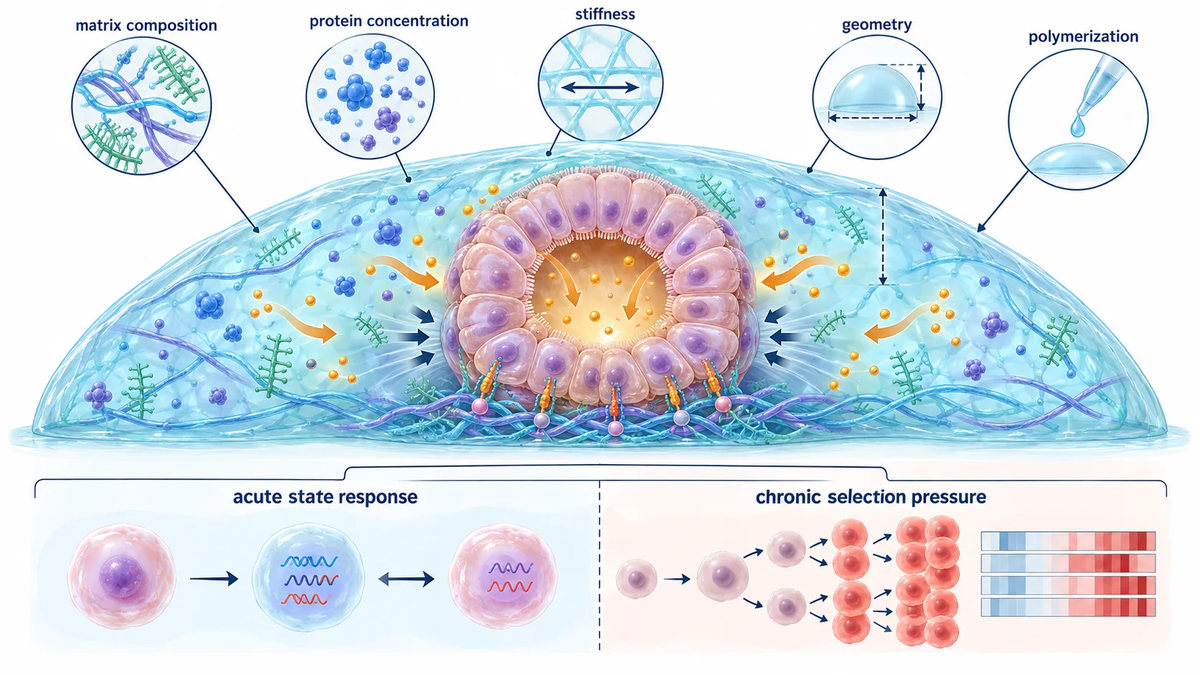 Figure 3. An organoid-matrix cross-section showing how matrix composition, concentration, stiffness, dome geometry, and handling alter cell-matrix signaling, diffusion gradients, and selection pressure over different time scales.
Culture Medium Is Both a Support System and a Selection Pressure
Medium maintains the model, but it also favors particular states. Growth-factor identity, concentration, delivery format, supplement stability, conditioned-medium preparation, and exchange frequency can alter proliferation, differentiation, metabolism, and stress responses. A medium-dependent RNA signature is not automatically evidence of model deterioration. It may be the expected response to a changed niche signal. The important question is whether the response reverses when the original condition is restored and whether it is accompanied by stable genomic or clonal change.
For each comparison, log the complete medium recipe and its effective exposure: basal formulation, supplements, growth-factor source and concentration, small molecules, conditioned-medium percentage, preparation date, storage history, thaw cycles, medium lot, exchange frequency, and deviations. "Same medium" is too vague if one culture received a different growth-factor batch or a different conditioning preparation. Recent reporting guidance specifically identifies transparent disclosure of medium identity, concentration, source, and batch activity as central to reproducible organoid work.
Bulk RNA-seq is usually the most efficient first readout for a planned medium comparison because it can show the size and direction of coordinated pathway shifts across matched replicates. If the question is whether a culture condition changes a drug-response program rather than only basal expression, organoid drug response transcriptomics can keep the molecular readout tied to a predefined perturbation. It should not be used to turn a culture-effect experiment into a broad efficacy claim.
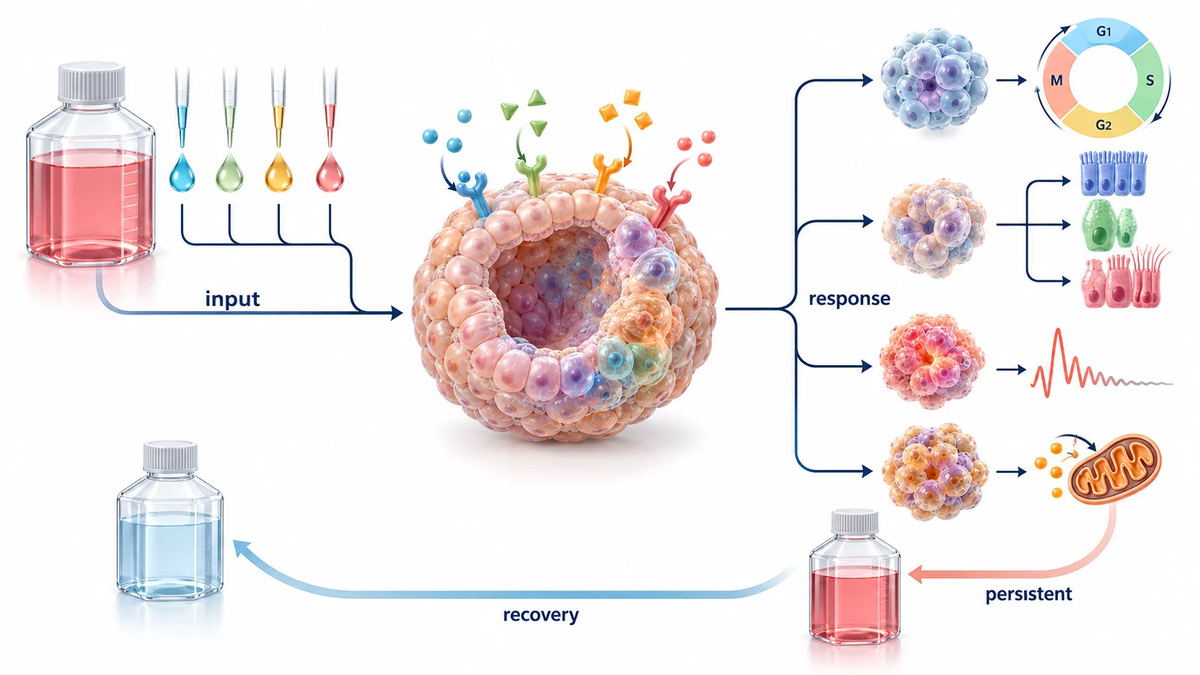 Figure 4. A medium-response map connecting defined growth-factor and supplement inputs to four measurable organoid outcomes: proliferation state, differentiation program, stress response, and metabolic adaptation, with reversible and persistent trajectories distinguished.
Use a Split-Source Design to Attribute Causality
The most informative study starts from a common source. Expand enough material under one reference condition, then split it into the planned culture arms at the same passage, on the same day, using the same dissociation method. This prevents unrelated history from being assigned to the new condition. A practical design is a 2 × 2 × 2 factorial comparison: early versus later exposure, matrix A versus matrix B, and medium A versus medium B. Not every project needs all eight combinations, but the design principle is important: vary the factor that you want to explain while holding the others constant or balancing them deliberately.
The value of a factorial design is not only that it estimates main effects. It can reveal interactions. A matrix may have little apparent effect under a reference medium yet strongly alter a differentiation program after a growth-factor change. In that situation, asking whether "the matrix" or "the medium" caused the shift is the wrong question. The useful conclusion is that the response depends on their combination within the tested range. Predefine which interaction would matter to the downstream use of the model and make sure there are enough matched biological lines to examine it.
Before sample collection, write the interpretation rules that the study is designed to test. For example, define an acute response as an early RNA shift that returns toward the reference profile after switch-back; define a reversible adaptation as a later shift that also recovers; and define a clonal-selection signal as a persistent molecular change accompanied by reproducible VAF or copy-number movement. These rules do not replace exploratory analysis. They prevent a convenient post hoc explanation from being applied to every pattern that emerges from sequencing.
For each biological line, include concurrent replicate wells or independent preparations appropriate to the culture system. Balance extraction batch, library-preparation batch, and sequencing lane across the condition arms. Do not process every matrix A sample on one day and every matrix B sample on another. If culture condition and sequencing batch are perfectly confounded, no downstream correction can prove which variable caused the observed difference.
Reserve matched DNA and RNA aliquots from the same collection point. That single planning choice creates the option to decide later whether an RNA shift has a DNA correlate. Organoid sequencing and analysis services can be structured around that paired comparison, while multi-omics services become appropriate only when an additional evidence layer is expected to change the interpretation. More assays do not rescue a confounded design.
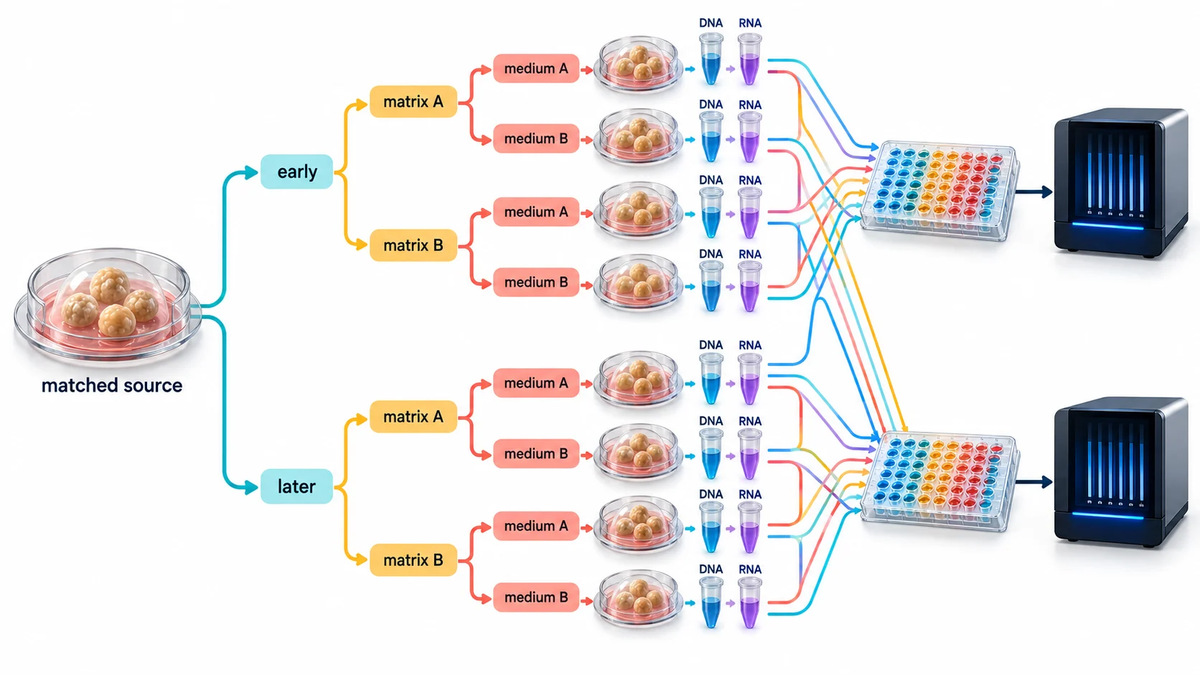 Figure 5. A split-source 2 by 2 by 2 factorial study design in which one matched organoid source is allocated across passage exposure, matrix, and medium factors, with DNA and RNA collected from every balanced condition arm.
Add a Switch-Back Experiment to Test Reversibility
A switch-back experiment is one of the simplest ways to make the conclusion stronger. Move material from the reference condition to the test condition, then return an aliquot to the reference condition for a defined recovery interval. Collect matched samples at baseline, after exposure, and after recovery. The recovery pattern helps classify the signal without requiring every study to begin with a large multi-omics package.
- Rapid shift, rapid recovery: consistent with an acute, condition-dependent state response.
- Gradual shift, recovery after return: consistent with a culture-adapted but reversible program.
- Persistent RNA shift without a detectable DNA correlate: suggests a durable epigenetic, compositional, or memory-like state that needs an assay selected for the remaining uncertainty.
- Persistent RNA shift with VAF or CNV movement: supports a clonal-selection hypothesis and justifies a more focused genomic follow-up.
The switch-back arm is not a guarantee of proof. Recovery can be incomplete because the chosen interval is too short, because the culture was not sampled at comparable growth phase, or because one condition changed the composition irreversibly. Its value is that it turns "the profiles differed" into a testable prediction about what should happen after the exposure is removed.
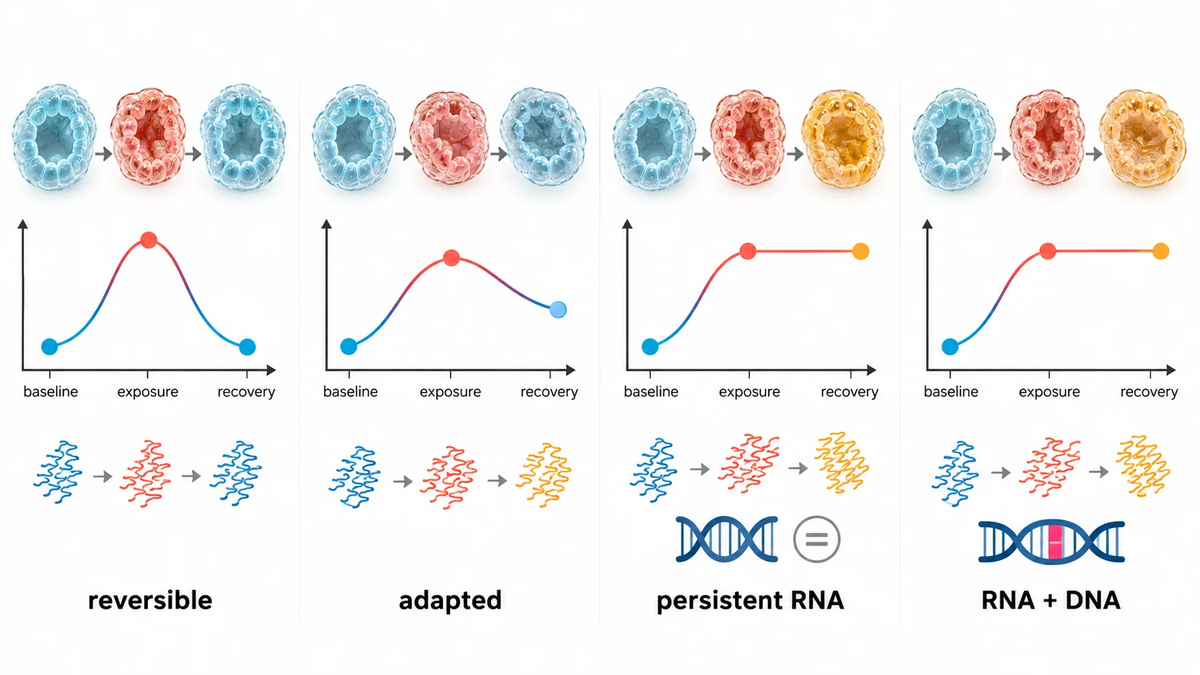 Figure 6. Four organoid switch-back trajectories showing immediate reversible response, gradual reversible adaptation, persistent transcriptomic change without DNA evidence, and persistent transcriptomic plus genomic change consistent with clonal selection.
Choose the Smallest Assay Set That Resolves the Drift Mechanism
The right assay set depends on what would change the next decision. Start with an assay that can reject the leading alternative explanation, then escalate only when the first result leaves a material ambiguity.
| Question | Minimum evidence set | Escalate when |
|---|---|---|
| Did a culture condition alter average expression programs? | Matched bulk RNA-seq with balanced processing and culture metadata | The result may be driven by changing cell proportions |
| Did clone structure or genomic dosage change? | Matched DNA comparison plus VAF/CNV interpretation | A broad or coding-region view is needed to test the observed pattern |
| Which cell state accounts for a bulk-RNA shift? | Cell-resolved transcriptomic profiling with matched culture context | Location within organoid architecture remains important |
| Is a persistent state associated with a regulatory change? | RNA evidence plus a targeted epigenetic hypothesis | The mechanism cannot be separated from cell composition or clone structure |
For a defined coding-variant question, variant calling analysis is most valuable when sample identity, reference build, filtering boundaries, and matched comparison are specified in advance. For a broader question about a lasting expression state, organoid epigenetic profiling may be a rational escalation after, not before, a well-controlled RNA result.
Analyze Drift as a Variance-Partitioning Problem
Analysis should estimate how much observed variation is associated with line, passage exposure, matrix, medium, and their interactions. A simple model can include a random effect for biological line and fixed effects for the controlled culture variables. The exact method depends on sample size and design, but the principle is stable: compare matched material within a line before making broad claims across lines, and report the factor structure that was actually estimable.
Batch correction can reduce unwanted technical variance. It cannot identify a culture effect that was never separated from batch experimentally. Preserve raw quality metrics, examine sample clustering against the design table, and inspect whether the dominant signal tracks a library run, collection date, medium lot, matrix lot, or biological condition. Differential-expression results should be interpreted alongside pathway-level coherence, morphology, growth kinetics, and—when relevant—composition evidence. A long gene list is not a mechanism.
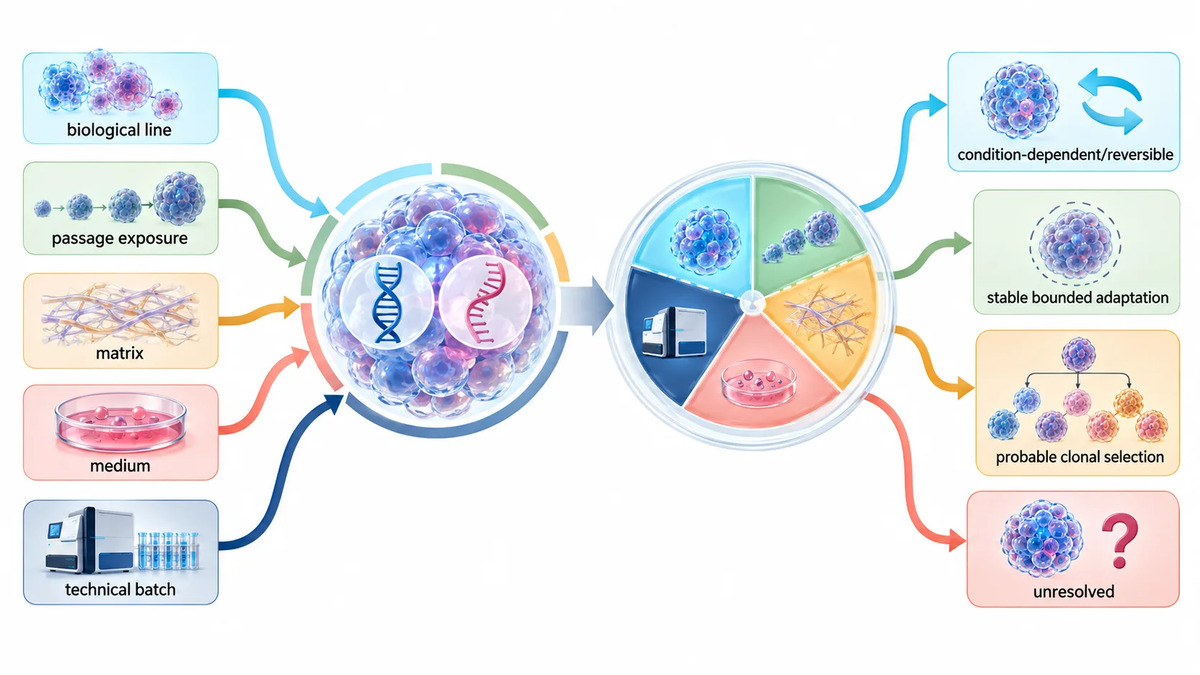 Figure 7. A variance-partitioning diagram for organoid molecular data showing biological line, passage exposure, matrix, medium, and technical batch as separate sources, followed by a decision path that classifies each observed change as reversible, stable, clonal, or unresolved.
Classify the Result Before Deciding What to Do
A useful conclusion is not "the model drifted." Classify the result using the evidence that the study can support.
- Condition-dependent and reversible: retain the condition as part of the experimental definition and avoid generalizing the state across media or matrix formats.
- Stable but bounded adaptation: document the exposure history, define the range in which the model remains fit for the intended question, and apply that boundary consistently.
- Probable clonal selection: preserve the DNA evidence, re-check the culture history, and decide whether the expanded culture still represents the biological question.
- Unresolved: do not infer a mechanism. Identify the missing control, then repeat a smaller and better-balanced comparison.
This classification is particularly important when the organoid is used for downstream target work. A molecular change can be real while still being unsuitable for extrapolation beyond the defined culture condition. Organoid target validation services can be planned around that boundary, with culture-state evidence included as context rather than silently treated as background noise.
Minimum Metadata for a Defensible Drift Study
The minimum record is not a universal form. It is the information required to reconstruct the comparison. At a minimum, retain: source and line identifiers; culture format; passage date and number; days since last split; split ratio; dissociation method; estimated density; matrix identity, lot, concentration, volume, and plating geometry; complete medium recipe and lot information; feeding schedule; thaw/recovery status; operator; collection time; extraction batch; library batch; sequencing run; and all deviations. Store the metadata with the sample identifiers that enter analysis, not in a separate notebook that cannot be joined to the sequencing files.
Also record what did not change. If one variable is held constant, preserve its identifier rather than writing "standard conditions." A matrix lot, medium batch, or dissociation reagent that is assumed to be stable may later be the only variable that distinguishes two data sets. A concise sample manifest with one row per collected aliquot is usually enough: it should connect the physical tube, culture arm, extraction, library, and analysis identifier without forcing analysts to reconstruct the study from file names.
For model development programs, this level of traceability can be integrated from the start through organoid model development services. For an existing bank, the immediate practical task is to identify which metadata are available and design the next comparison around the missing variables rather than treating them as unknowable.
A Practical Drift-Attribution Workflow
- Define the decision. State what downstream interpretation would change if the result is reversible adaptation versus stable clonal selection.
- List the plausible drivers. Passage exposure, matrix, medium, density, thaw recovery, and technical batch should be separated before assay selection.
- Start from a common source. Split matched material into controlled arms and balance downstream processing.
- Collect DNA and RNA from aligned culture points. This preserves the option to test whether an expression shift has a genomic correlate.
- Add a recovery arm where feasible. A switch-back test often gives more informative evidence than adding an unbalanced assay.
- Classify the pattern. Report reversible, stable, clonal, or unresolved—not a broader conclusion than the data support.
Frequently Asked Questions
Is there a universally safe maximum passage number for organoids?
No. Passage number does not capture split ratio, culture duration, population doublings, bottleneck severity, matrix exposure, or medium history. Define a fit-for-purpose range for the specific line and readout instead of applying a universal cutoff.
Can RNA-seq alone prove that a condition caused genomic drift?
No. RNA-seq can show a reproducible expression response, but it cannot on its own establish acquired variants, copy-number change, or clonal selection. Pair it with the DNA evidence needed for the biological decision.
How can we tell whether a matrix effect is reversible?
Use a common-source split, collect an early exposure sample, and include a return-to-reference condition. A response that moves back toward baseline after the switch supports reversibility within the tested recovery window.
Should we correct medium or matrix effects away computationally?
Only correct technical factors that are independently represented in the design. A biological culture condition should not be removed as "batch" when it is part of the question. Fully confounded variables cannot be repaired after sequencing.
When should cell-resolved profiling replace bulk RNA-seq?
Escalate when the central uncertainty is whether a bulk signal arises from altered cell proportions rather than changed state within a population. It is not required for every medium or matrix comparison.
What is the most useful first follow-up after seeing a passage-associated difference?
First inspect the culture history and experimental design. Then perform a matched, split-source comparison with balanced processing. The next assay should test the most consequential competing explanation, not simply add more data.
References:
- VanDussen KL, Karakasheva TA, Mahe MM, et al. Guiding Principles: Reporting Elements for Gastrointestinal Organoid Research. Cellular and Molecular Gastroenterology and Hepatology. 2026; DOI: 10.1016/j.jcmgh.2026.101772.
- Usman OH, et al. Genomic heterogeneity in pancreatic cancer organoids and its stability with culture. npj Genomic Medicine. 2022;7:71. DOI: 10.1038/s41525-022-00342-9.
- Price S, et al. A suspension technique for efficient large-scale cancer organoid culturing and perturbation screens. Scientific Reports. 2022;12:5571. DOI: 10.1038/s41598-022-09508-y.
- Giobbe GG, et al. Extracellular matrix hydrogel derived from decellularized tissues enables endodermal organoid culture. Nature Communications. 2019;10:5658. DOI: 10.1038/s41467-019-13605-4.
- Zhou C, et al. Standardization of organoid culture in cancer research. Cancer Medicine. 2023;12:14375-14386. DOI: 10.1002/cam4.5943.
- International Society for Stem Cell Research. Section 5: Reporting. Online research-reporting standard; accessed October 2026.
Related Services
- Organoid Research and Sequencing Solutions
- Organoid Characterization Services
- Organoid Whole Exome Sequencing Services
- Organoid Sequencing and Analysis Services
- Organoids Sequencing Service
- Organoid Epigenetic Profiling Services
- Organoid RNA Stability Analysis Services
- Custom Epithelial Organoid Services
For research use only. Not for use in diagnostic procedures, clinical decision-making, patient stratification, therapeutic selection, or clinical trials.