

 Sample Submission Guidelines

A Sequencing-Based Framework for Organoid Model Qualification
Meta Intent: A practical research framework for deciding whether an organoid model has sufficient identity, contamination, genomic, and expression evidence for its intended experiment, and for defining the next action when those signals disagree.
An organoid can grow well, produce a usable DNA or RNA extract, and still be unsuitable for the experiment being planned. It may be misidentified, affected by an undetected contaminant, dominated by an unintended cell population, or missing a molecular feature that the study assumes is present. These are different failure modes. They should not be compressed into one generic label such as "QC passed."
Model qualification is the process of assembling evidence that a particular culture is fit for a defined research use. It begins with provenance and identity, then checks contamination status, confirms the molecular features that matter to the question, and asks whether the present cell state can support the intended readout. Sequencing is central because it can reveal genomic features, transcriptomic state, and unexpected material. It is not a substitute for every other check. A sequencing result must be interpreted alongside sample history, dedicated contamination testing, morphology, and the limits of the assay that produced it.
This guide is intended for researchers deciding whether a newly established, expanded, thawed, or externally acquired organoid line should enter a research study. It focuses on the evidence needed for a current decision, rather than prescribing one universal certification score. For projects that start at model derivation, organoid model development services can help align establishment, expansion, banking, and fit-for-purpose assessment with the biological comparison that follows.
Qualification Is Not a Single Test
The first question is not "Which assay should be run?" It is "What conclusion must this model support?" A line used to compare broad stress responses may need a different evidence package from a tumor organoid intended for a variant-linked functional study, a differentiated epithelial model used for barrier research, or a long-term resource prepared for sharing. The required evidence should be proportionate to the consequence of being wrong.
A useful framework separates four questions:
- Provenance: Can the culture, sample, library, and data files be traced to the intended source and culture history?
- Identity and integrity: Does the line match the expected donor or source, and is there evidence of a sample swap or unintended admixture?
- Current biological condition: Is the culture free from contaminants and overt structural problems that would invalidate the planned work?
- Use-specific molecular evidence: Does it retain the genomic or expression feature required by the research question?
These questions should yield an action, not only a result. "Proceed," "proceed with a stated limitation," "hold for review," and "do not use for this experiment" are more useful outcomes than a color code alone. They also protect teams from treating a historical report as proof that a living, continuously changing culture remains fit for every later use.
 Figure 1. Organoid model qualification integrates provenance, identity, contamination status, molecular evidence, and a fit-for-purpose decision.
Start with a Traceable Model Record
Sequencing cannot repair a broken chain of identity. Before material is collected, a model record should connect the source specimen or cell line, organoid line ID, culture route, current passage or time in culture, matrix and medium, freeze–thaw history, and planned research use. The same identifier should follow aliquots through extraction, library preparation, sequencing, analysis, and reporting.
This is particularly important when a study contains multiple organoid lines from one donor, matched normal and tumor material, or several culture branches derived at different times. "Same donor" does not automatically mean "same model," and "same model name" does not guarantee that two aliquots share the same handling history. The record should make those distinctions visible rather than leaving them in lab notebooks or file names.
A compact pre-sequencing handoff table is often enough: model ID, source material, collection or derivation date, passage window, matrix and medium condition, last mycoplasma result, current morphology note, planned assay, and extraction date. This is not administrative overhead. It is the minimum context needed to decide whether an apparent molecular difference is biological or a history mismatch. An integrated organoid research and sequencing solution can connect model context to the selected molecular readout and comparison plan.
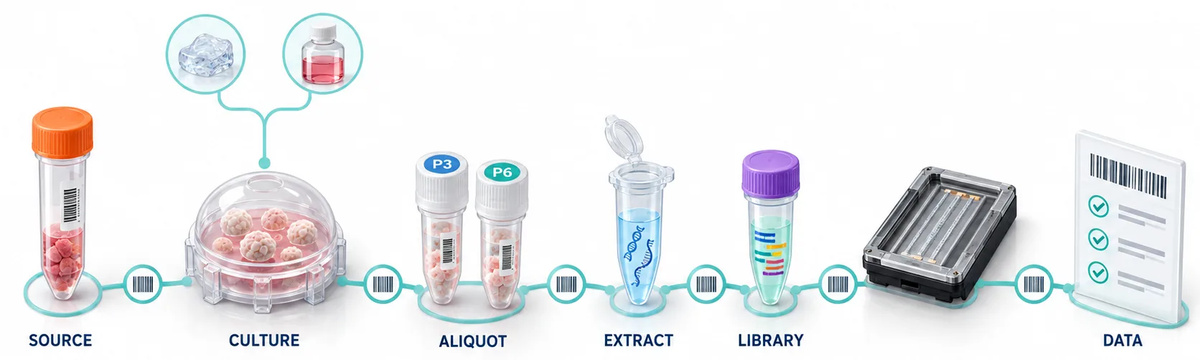 Figure 2. A traceable model record links source material, organoid culture history, aliquots, sequencing libraries, and final data files.
Identity Evidence Answers a Specific Question
Identity testing asks whether the culture is the line it is supposed to be. For human-derived organoids, STR profiling or a suitable SNP-based approach can establish a reference fingerprint and compare subsequent material against it. When broad sequencing has already been planned, informative SNPs can add a second line of support. Genomic profiling is not automatically an identity test unless the reference, marker coverage, matching method, and interpretation rule were specified for that purpose.
A robust interpretation separates three situations. A clear mismatch requires immediate investigation of a potential sample swap or cross-contamination event. A partial or ambiguous match requires review of DNA quality, tumor-associated copy-number change, mixed populations, and the technical scope of the assay. A strong match confirms provenance at the tested loci, but does not establish that the model retains every biological feature needed for the study. Cell line authentication services provide a focused route when the key question is a human-cell identity fingerprint rather than whole-transcriptome or genome-wide characterization.
For tumor-derived cultures, identity and tumor representation are related but distinct. A culture can match a donor by STR and still be enriched for non-neoplastic epithelium. It can also preserve a donor-level fingerprint while a key subclone becomes depleted. Those questions belong to molecular qualification and purity assessment, not to a simplistic interpretation of the identity test. The later matrix article on normal-cell overgrowth will address tumor purity in depth; this article uses purity only as a trigger for escalation.
| Evidence type | Primary question answered | What it cannot establish alone | Action if unclear |
|---|---|---|---|
| STR or SNP fingerprint | Does this culture match the expected source? | Current cell state or pathway activity | Repeat from a fresh aliquot and compare with the source reference |
| Targeted DNA sequencing | Is a required variant detectable within the covered panel? | Genome-wide stability or expression state | Check coverage and reference material before inferring loss |
| WES or WGS | Are broader variants and copy-number patterns available for comparison? | Dedicated microbial negativity or tissue architecture | Review assay limits and use orthogonal checks where needed |
| RNA-seq | Is an expected expression program present in the harvested material? | Whether a signal arose from cell-state or composition change | Use targeted validation or single-cell escalation when central |
Contamination Is a Separate Gate
Contamination status should not be inferred casually from a sequence-data summary. A human RNA-seq or exome library may not be designed to detect mycoplasma, other microbes, or low-level mixed material with the required sensitivity. Dedicated testing remains the appropriate primary gate for routine contamination control, while broad sequencing can contribute supporting evidence or help investigate an unexpected signal.
Mycoplasma deserves particular attention because it may not be visible in routine culture inspection and can alter growth, molecular profiles, and response assays. If a line is positive or suspected positive, the appropriate immediate action is isolation and review of the intended experiment, not a decision to continue because the planned library is technically acceptable. A study in colorectal patient-derived organoids showed that mycoplasma status could affect growth and drug-response measurements, underscoring why contamination status must be known before functional interpretation.2
Cross-species signals also require context. A mouse-DNA signal in a human organoid culture may arise from viable feeder-derived material, an actual mixed culture, or cell-free DNA introduced through conditioned medium or other reagents. In one study, cultures with mouse DNA detected by PCR did not show evidence of active mouse transcription by RNA-seq, illustrating why a single positive signal should trigger a targeted investigation rather than an automatic biological conclusion.3 The review should include reagent blanks, culture components, positive and negative controls, and an assay suited to the suspected material.
Where a project requires microscopy-based confirmation of structure, lumen orientation, or a selected marker panel alongside molecular findings, organoid histology services can supply complementary evidence. Orthogonal evidence is not duplication. It reduces the risk of using one measurement to answer a question it was not designed to answer.
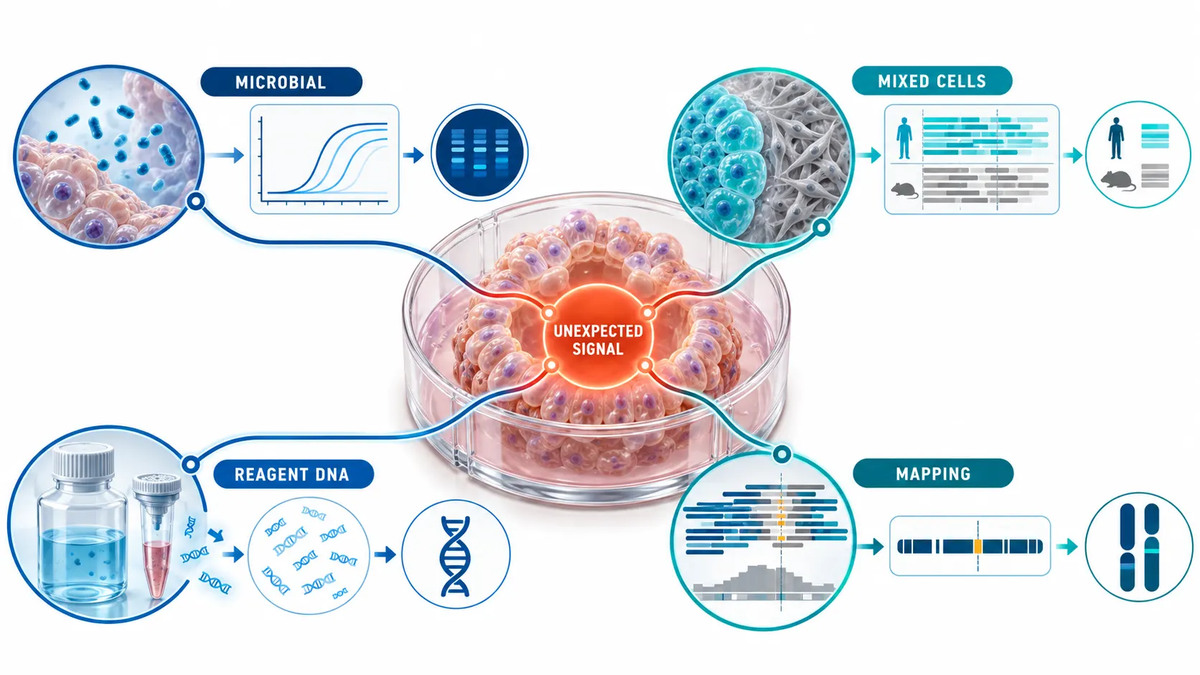 Figure 3. A contamination triage distinguishes microbial contamination, mixed-cell material, reagent-derived nucleic acid, and mapping background.
Select DNA Evidence for the Decision You Need to Make
Genome-scale data should be selected because they resolve a defined uncertainty, not because a larger assay automatically makes a qualification decision stronger. A targeted panel is efficient when the study depends on a known set of edits, driver variants, or locus-specific alterations. Whole-exome sequencing adds wider coding-region coverage when the aim is to compare mutation profiles or establish a broader variant baseline. Whole-genome approaches may be justified when noncoding variation, large-scale structure, or a comprehensive genomic reference is essential to the program.
The interpretive discipline is the same at every scale: identify the required features before reviewing the data, record the coverage and detection limits at those features, and distinguish "not detected" from "not assessable." A missing call at a poorly covered locus is not evidence that the feature has been lost. A changed variant allele fraction is not, by itself, proof of genetic drift; it can also reflect composition, copy-number context, or sample handling. Those explanations should be resolved in a targeted follow-up plan.
For studies that require a source-to-model genomic comparison, organoid whole-exome sequencing services can support matched model analysis with coverage and variant-quality records. The analysis should remain anchored to the research question: confirm an edit, retain a defined driver set, evaluate a candidate genomic feature, or create a baseline for future comparison. A generic list of variants is not yet a qualification conclusion.
The next article in this matrix will examine whether patient-derived organoids match the original tissue through an integrated multi-omics fidelity framework. That is a deeper tissue-to-model concordance question. Here, the narrower goal is to establish whether the present model contains the genomic evidence required to enter the planned research experiment.
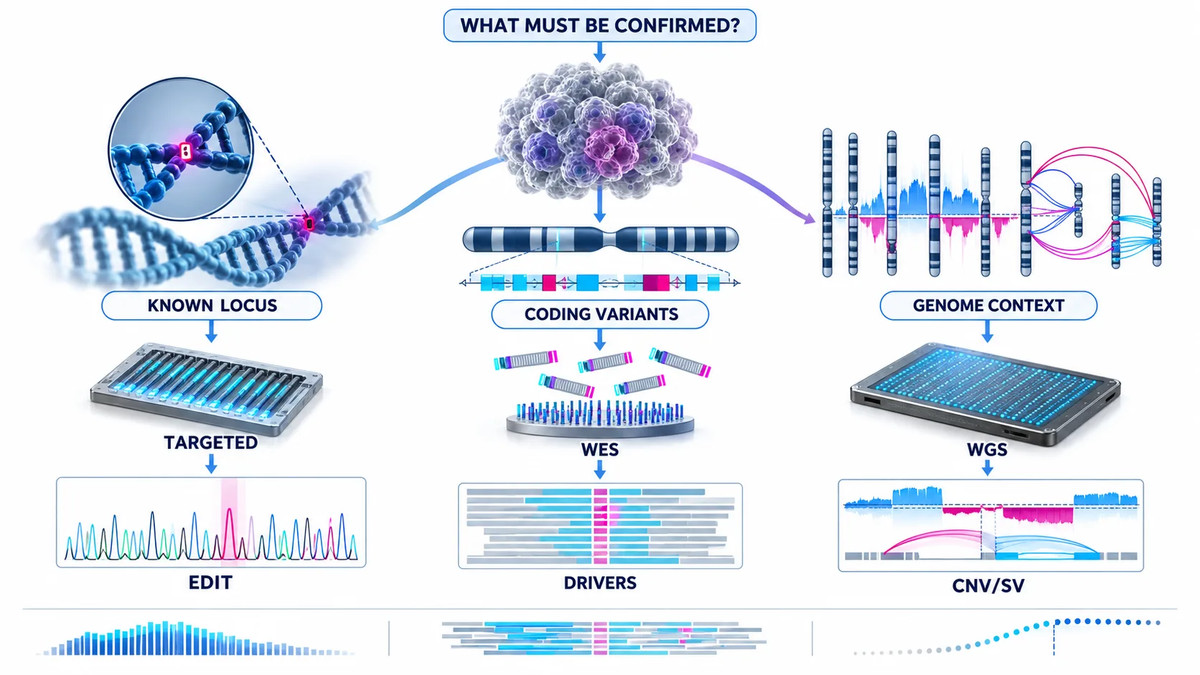 Figure 4. A decision tree routes organoid genomic questions to targeted sequencing, whole-exome sequencing, or broader genome-scale analysis.
Expression Data Need Two Levels of Quality Control
RNA-seq is often the most direct way to determine whether a model exhibits the expression program relevant to an experiment. Yet there are two separate layers of interpretation. Technical sequencing QC evaluates the suitability of RNA, library construction, read quality, alignment, gene assignment, and sample representation. Biological qualification asks whether the harvested material shows the cell-state, lineage, differentiation, stress, or target-expression context required by the study. Passing the first layer does not guarantee the second.
For example, a high-quality library may reveal that a culture is strongly stress-responsive, poorly differentiated, or shifted toward a cell population not aligned with the intended assay. That result is not a failed sequencing run. It is useful evidence that the model should be held, re-characterized, or used only with a stated limitation. Conversely, one or two marker genes should not be used to certify a complex organoid state. Interpret marker sets, pathway patterns, morphology, and the model's intended function together.
A well-designed RNA-seq study preserves the biological unit in the metadata: donor or line, independent culture preparation, passage, matrix, medium, treatment status, and harvest route. Organoid sequencing and analysis services can help route bulk, single-cell, spatial, DNA, and epigenomic approaches according to the specific uncertainty, rather than assigning the most complex assay by default.
Single-cell RNA-seq becomes useful when a model-level bulk profile cannot separate cell-state change from a shift in the abundance of populations. It should be an escalation decision, not a reflex. If the core question is a replicated sample-level expression program, bulk RNA-seq may be the clearest first answer. If the issue is the presence of a rare population, mixed lineage, or composition shift, single-cell profiling may be justified. The decision should be stated before the dataset is used to support a model qualification claim.
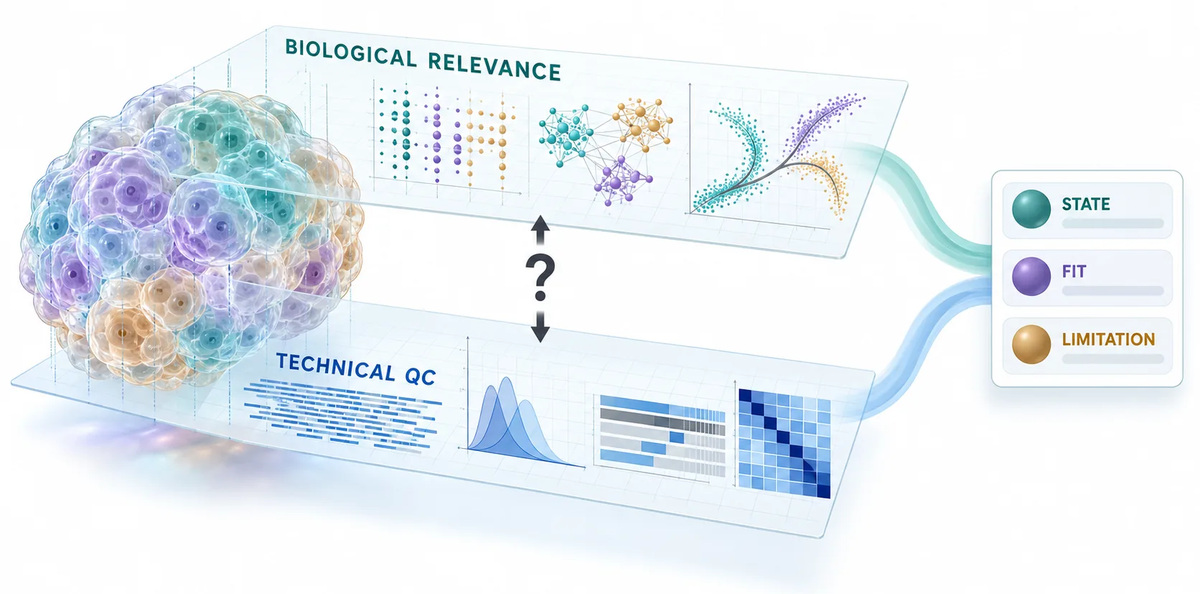 Figure 5. Technical sequencing quality and biological model relevance are separate evidence layers for organoid RNA-seq qualification.
Do Not Average Away Disagreement Between Evidence Types
The most valuable qualification work often begins when results disagree. A model may have a matching STR profile but lack a required variant. It may retain the expected driver set but show a transcriptional state inconsistent with the experiment. It may return a cross-species DNA signal even though there is no evidence of actively transcribing nonhuman cells. A good report identifies the mismatch and specifies what it means for use.
Use a short, structured review:
- Confirm that the compared materials and file identifiers are traceable.
- Check whether the result falls within the detection scope of the assay.
- Review culture history, reagent background, extraction route, and relevant controls.
- Select the smallest orthogonal test that can distinguish the leading explanations.
- Define whether the model may proceed, proceed with a limitation, or must remain on hold.
This approach prevents two common errors. The first is dismissing a discordant result as "technical noise" without examining its origin. The second is over-interpreting a single result as proof of a biological event. For a clearly defined edit or target-expression question, organoid target validation services can add focused molecular and phenotype evidence without automatically expanding the study into an unnecessary genome-wide program.
Use an escalation rule, not a larger default panel
Escalation works best when it is predefined. If identity is ambiguous, the next test should improve the source comparison. If a key variant is uncertain, the next step should improve target coverage, quantify the alternative allele fraction, or inspect the calling assumptions. If a bulk RNA-seq profile suggests an unexpected state, the next step may be a focused marker check, histology, or cell-resolved assay. A broad retest without a specific uncertainty can consume scarce organoid material without improving the decision.
Variant review is especially vulnerable to this problem. The report should state reference build, calling method, filters, coverage, and whether a comparison was tumor-normal, organoid-only, or panel-of-normals based. Variant calling services can support transparent review of those parameters so that a model qualification conclusion is linked to the evidence that actually supports it. This is different from the next matrix article's deeper question of whether a model faithfully represents the original tissue across multiple omics layers.
Make the Qualification Decision Visible
A qualification record should make it possible for a researcher who did not establish the culture to understand why it was released for one use and not another. The record should include the model ID, declared intended use, source and culture context, test method and version, test date, main finding, assay limitations, any discrepancy, resolution step, and final use decision.
| Decision state | Appropriate evidence pattern | Practical next step |
|---|---|---|
| Proceed | Core identity, contamination, and use-specific evidence are consistent | Release for the defined research experiment and retain the record |
| Proceed with limitation | Core evidence is adequate, but a non-critical uncertainty is documented | State the boundary in the experiment plan and do not extend the conclusion beyond it |
| Hold for review | Anomaly, incomplete result, or important conflict remains unresolved | Run the prespecified confirmatory test before experimental use |
| Do not use for this study | Identity, contamination, or required molecular evidence is incompatible with the planned interpretation | Quarantine, replace, re-derive, or select an alternative line as appropriate |
This framework does not assign a universal numeric pass threshold. The evidence boundary for a matched fingerprint, a required variant, or an acceptable expression range should be specified prospectively from the model type, source evidence, and intended research use.
The record should retain unsuccessful checks and revisions, rather than displaying only the final green status. Large organoid biobank initiatives increasingly pair renewable models with molecular and biospecimen annotation, reinforcing that reproducibility depends on the audit trail as well as the final molecular profile.4 For a broader project that needs coordinated model development, qualification, functional work, and sequencing, organoids sequencing services can connect the evidence plan to the intended downstream comparison.
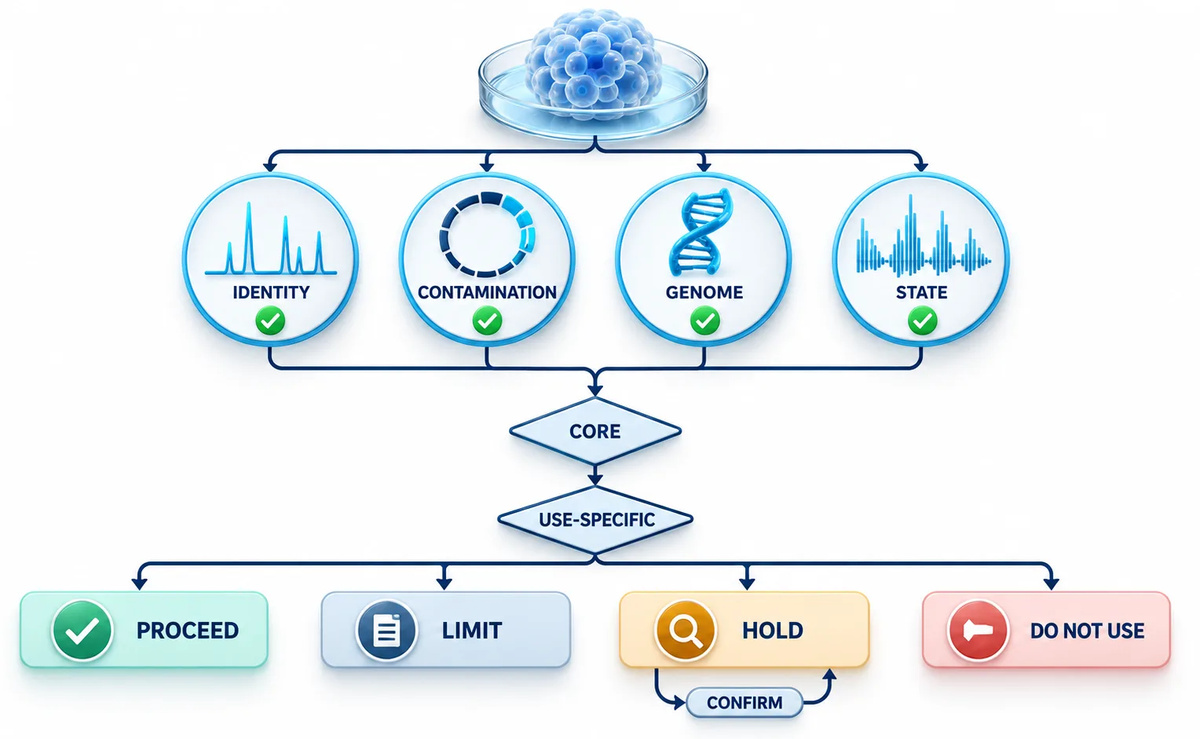 Figure 6. A fit-for-purpose decision tree classifies organoid models as proceed, proceed with limitation, hold for review, or do not use.
A Minimum Qualification Workflow Before Research Use
The same model does not need every possible assay before every experiment. A proportionate workflow is more durable than a long, unprioritized checklist. Start with the study claim that the model must support, then use the smallest evidence package capable of testing that claim and the largest plausible failure mode.
- Define the intended experiment and the molecular feature or biological state it requires.
- Freeze the model identity, culture history, and aliquot-to-file identifiers in a traceable record.
- Review dedicated contamination status before processing valuable material.
- Run or review identity evidence against a defined source reference.
- Select DNA, RNA, or multi-omics evidence that directly addresses the intended use.
- Interpret technical QC and biological relevance separately.
- Escalate only where an unexpected or conflicting signal changes the research decision.
- Document the decision state, limitations, and next review trigger.
Define a minimum evidence set before testing begins: source-linked identity, a dedicated contamination result, and the molecular feature without which the planned experiment cannot be interpreted. Treat further assays as escalation evidence, triggered only by a prespecified uncertainty such as an unexpected phenotype, incomplete coverage, discordant results, or a change in model use. This keeps qualification proportionate without averaging away a decision-relevant failure mode.
This is also where a single all-purpose "qualification panel" often fails. A model used for a short gene-perturbation experiment may need confirmed identity, microbial status, targeted edit verification, and compatible target expression. A model intended as a renewable comparison resource may additionally require a structured molecular baseline and broader annotation. Organoid characterization services can help organize the baseline morphology, marker, genomic, and expression evidence around the model type and stated research objective.
The workflow is for research use. It does not replace model-specific safety procedures, local biosafety requirements, or use-specific validation. Its purpose is simpler: make the evidence behind an organoid research decision explicit, proportionate, and reusable.
Frequently Asked Questions
Does a matching STR result prove that an organoid is ready for any experiment?
No. It supports source identity but does not establish contamination status, current cell composition, required genomic features, or the expression state needed for a particular study.
Can WES replace routine mycoplasma testing?
No. WES is not ordinarily designed or validated as a routine mycoplasma release test. Use a dedicated contamination assay and treat sequencing signals as supporting or investigational evidence.
What should be done when a required variant is not detected?
First check sample identity, target coverage, assay sensitivity, and the original reference material. "Not detected" should not be interpreted as biological loss until those boundaries are reviewed.
When is bulk RNA-seq enough for model qualification?
It is often sufficient for a replicated, model-level expression question. Escalate to single-cell analysis only when cell composition or a rare population is essential to the conclusion.
Should a model with an unresolved discrepancy be discarded?
Not automatically. It should be held for the relevant experiment while the smallest informative confirmation step is performed. Some discrepancies arise from reagents, pre-analytics, or assay scope rather than an unusable model.
Can a model be qualified once and used indefinitely?
No. Qualification evidence applies to a stated culture point and intended use. Reassess when major expansion, thaw recovery, culture-format change, an unexpected phenotype, or a new experimental purpose could alter the interpretation.
References:
- Lee H, Yang S, Lee KJ, et al. Standardization and quality assessment for human intestinal organoids. Frontiers in Cell and Developmental Biology. 2024;12:1383893. DOI: 10.3389/fcell.2024.1383893. CC BY.
- Dayanidhi DL, Watlington WK, Mantyh JB, et al. Effects and eradication of mycoplasma contamination on patient-derived colorectal cancer organoid cultures. Cancer Research Communications. 2023;3:1952–1961. DOI: 10.1158/2767-9764.CRC-23-0109. CC BY 4.0.
- Bohm MS, Dame MK, Boyd J, et al. Low-level mouse DNA in conditioned medium generates false positive cross-species contamination results in human organoid cultures. Frontiers in Cell and Developmental Biology. 2020;8:587107. DOI: 10.3389/fcell.2020.587107. CC BY.
- Herranz-Ors C, Bhosle SG, Beck AE, et al. A tumour-derived organoid biobank maps cancer gene dependencies. Nature. 2026. DOI: 10.1038/s41586-026-10830-y. CC BY 4.0.
Related Services
For research purposes only, not intended for clinical diagnosis, treatment, or individual health assessments.