

 Sample Submission Guidelines

From GWAS Loci to Effector Genes with Promoter-Interaction Mapping
Meta Intent: A practical decision framework for prioritizing defensible effector-gene hypotheses at immune-disease GWAS loci by integrating fine mapping, cell-state-specific promoter contacts, molecular QTLs, and functional validation.
Genome-wide association studies can identify robust genetic signals without identifying the gene through which those signals act. That distinction matters most at immune-disease loci, where associated variants are commonly noncoding, linkage disequilibrium can leave many plausible candidates, and the nearest gene may be unrelated to the operative regulatory mechanism. A promoter interaction map can make a locus more interpretable, but it is not a shortcut to causality. It is one evidence layer in a design that must connect variant, regulatory element, promoter, expression consequence, and perturbation result.
This guide explains how to build that design. It is intended for research teams planning a locus-to-gene project, commissioning a 3D-genome dataset, or deciding whether a chromatin contact adds enough evidence to justify downstream experiments. The practical endpoint is not a long candidate-gene list. It is a ranked, auditable evidence package that states what is observed, what is inferred, and what still needs testing.
Why a GWAS Locus Is Not an Effector Gene
A lead SNP is an association marker, not automatically a causal variant; a causal variant is not automatically a promoter-contacting regulatory element; and a contacted promoter is not automatically the gene that mediates the phenotype. One locus can contain several statistically credible variants, several accessible regulatory elements, and several genes within the same topological neighborhood. Assigning the nearest transcript as the target collapses all of those uncertainties into a single unsupported conclusion.
Start instead with a chain of explicit questions. Which variants remain plausible after ancestry-aware fine mapping? In which immune cell type and activation state is the locus accessible? Does the credible-set interval connect to a promoter in that state? Does the implicated gene have compatible expression or QTL evidence? Finally, does perturbing the element, allele, or gene produce the predicted molecular change? A genome-wide association study provides the statistical starting point; it does not remove the need for this experimental chain.
For many projects, the most useful output is therefore a tiered statement rather than a binary call. For example: "Variant group A is prioritized because it lies in accessible chromatin in stimulated CD4 T cells, contacts promoter B in the same state, and co-localizes with expression evidence; functional perturbation is pending." This preserves the scientific value of a strong hypothesis without presenting a contact map as proof.
 Figure 1: The Evidence Chain from GWAS Signal to Effector-Gene Hypothesis. A locus-to-gene claim becomes more defensible as statistical, regulatory, spatial, expression, and perturbation evidence converge in the same biological context.
Start with a Credible Set, Not a Lead Variant
Promoter mapping is most informative when the input interval has already been narrowed honestly. Fine mapping converts a broad association neighborhood into a credible set: a set of variants whose combined posterior inclusion probability is expected to contain the causal signal under the chosen model. The exact algorithm can vary, but the deliverable should always preserve the study ancestry, linkage-disequilibrium reference, credible-set threshold, number of independent signals, and posterior inclusion probability for each candidate.
Do not submit an arbitrary genomic window to a promoter-contact analysis merely because it contains the lead SNP. First evaluate whether the association may contain more than one signal; whether the LD panel matches the study population; and whether imputation quality or genome build creates a coordinate mismatch. A well-defined SNP fine mapping workflow reduces the chance that downstream assay depth is spent on variants that were never credible candidates.
Fine mapping also changes how chromatin contacts should be scored. A loop overlapping a low-probability proxy SNP should not receive the same weight as a loop overlapping a high-PIP candidate in open chromatin. A practical locus sheet should retain each candidate variant's PIP, overlap with accessible or marked regulatory DNA, contact partner, and cell-state label. This is more transparent than coloring every SNP in LD as if it carried equal evidence.
Build-specific and allele-aware checks
Before any integration, harmonize all tracks to one reference assembly and document liftover failures. Verify reference/alternate allele orientation, dbSNP identifiers, and the allele used in eQTL or chromatin-accessibility analyses. A single unresolved strand issue can invert allelic directionality and make an otherwise credible locus narrative misleading. When the project starts from sequencing data, a reproducible variant calling workflow should preserve coverage, genotype quality, allele balance, and filtering rationale alongside the final variants.
Choose the Immune Cell State Before Choosing the Contact Assay
Immune-disease risk loci are often active in a restricted lineage, differentiation stage, or stimulation window. A promoter interaction detected in resting bulk blood cells may be biologically real yet uninformative for a locus whose regulatory activity emerges after receptor activation, cytokine exposure, or lineage polarization. Conversely, a contact absent from one condition is not evidence that it never occurs. It may simply be below detection in the sampled state.
Define the biological context before choosing sequencing depth. Start with disease-relevant cell classes, then refine the question: resting versus activated, tissue-resident versus circulating, early versus late stimulation, or broad population versus a rare subpopulation. Chromatin accessibility can provide a useful first filter. Bulk ATAC-Seq is suitable when the chosen cell population is reasonably homogeneous; single-cell ATAC-seq becomes valuable when a bulk signal could be diluted by mixed cell states.
Expression must be sampled in the same or a deliberately comparable context. An eQTL from unrelated tissue can nominate a useful hypothesis, but it should not overrule state-matched evidence. Pairing contact maps with RNA-Seq helps distinguish a promoter that is physically contacted from a candidate gene that is both contacted and transcriptionally plausible in the studied cells.
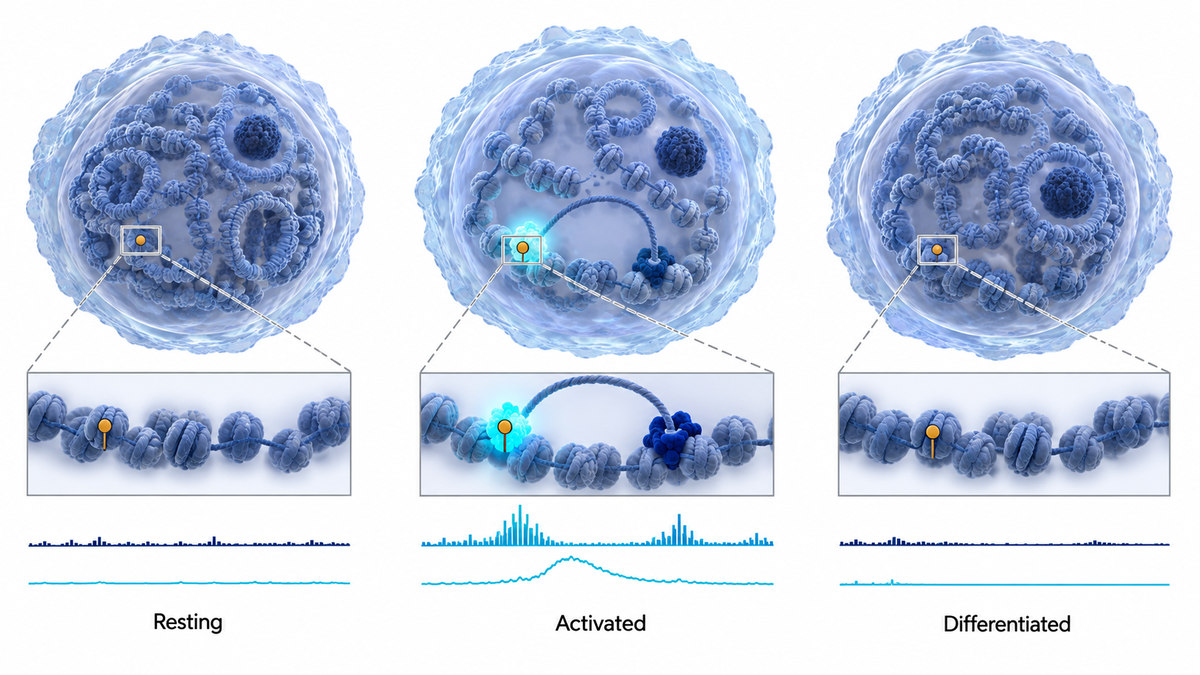 Figure 2: Cell-State Selection for Immune-Disease Promoter Mapping. The same fine-mapped interval can have different accessibility, enhancer activity, and promoter contacts across resting, activated, and differentiated immune-cell states.
Match the Promoter-Interaction Assay to the Question
No single 3D-genome method answers every locus-to-gene question. Genome-wide Hi-C is useful for broad architecture, compartments, and large-scale domain context. It is less efficient when the central question is whether a limited set of noncoding immune-risk intervals contact particular promoters. Promoter capture Hi-C or promoter Capture-C enriches promoter-containing ligation products and can provide more targeted interaction information. Region-capture approaches are particularly useful when the project has a defined locus panel. Protein-anchored assays such as HiChIP or PLAC-seq enrich contacts associated with a chosen chromatin mark or protein and are best interpreted as mark- or factor-associated interaction maps, not universal promoter maps.
For an exploratory, genome-wide architecture question, Hi-C sequencing may be the appropriate starting point. For a focused gene-regulatory question, capture design should be built around credible-set intervals and nominated promoter regions. For a project centered on active regulatory circuitry, pair the contact data with ChIP-Seq or accessibility data rather than assuming every observed ligation frequency has equivalent regulatory meaning.
| Question | Most informative starting design | Interpretation boundary |
|---|---|---|
| Which loci sit in the same broad 3D neighborhood? | Genome-wide Hi-C | Domain context does not identify a causal enhancer or gene. |
| Which promoters contact a preselected GWAS interval? | Promoter Capture-C or promoter capture Hi-C | Contact frequency is population-averaged and context dependent. |
| Which active promoter or enhancer contacts change in a defined cell state? | HiChIP or PLAC-seq plus accessibility/mark profiling | The enrichment target shapes which contacts are visible. |
| Does one nominated enhancer regulate one candidate gene? | Targeted capture plus perturbation | Orthogonal functional testing is still required. |
This design logic complements, rather than repeats, an overview of Hi-C sequencing: the critical planning decision here is not the method name but whether the data can answer a variant-to-promoter question in the chosen biological state.
Set QC Gates Before Calling Variant-to-Promoter Links
A visually appealing arc plot is not a QC report. The project plan should define required metrics before sequencing begins: library complexity, duplicate fraction, valid-pair rate, cis/trans distribution, distance-decay behavior, capture enrichment when applicable, replicate concordance, and the number of usable contacts at the intended resolution. These metrics should be reviewed separately for each cell state and biological replicate. Pooling weak replicates may create an attractive aggregate map while hiding an unstable signal.
Contact callers and loop thresholds should be locked before the final candidate ranking. When a locus falls into a repetitive region, high-copy sequence, or a densely interacting promoter neighborhood, report the mapping ambiguity rather than selecting the most convenient gene. It is equally important to retain negative controls: matched inactive cell types, non-risk loci, and promoter regions expected to be constitutively active. Those controls help distinguish a broad technical contact background from context-enriched evidence.
Recommended minimum metadata
- Donor or sample source, cell-isolation method, purity assessment, activation and harvest timing.
- Genome build, restriction or fragmentation strategy, capture bait design, aligner, contact caller, and fixed thresholds.
- Per-library QC, biological-replicate concordance, and the exact set of intervals considered testable.
- A record of intervals excluded for low mappability, insufficient coverage, or coordinate uncertainty.
Map the Credible Set to Contacts Without Inflating the Claim
The integration step should work from variant to element to promoter, not directly from lead SNP to gene. Overlay credible-set variants on accessible chromatin, active regulatory marks, transcription-factor occupancy where relevant, and promoter contacts in the same cell state. Then score each candidate element–promoter link using predeclared evidence fields. A simple starting score can weight PIP, state-matched accessibility, contact reproducibility, gene expression, and QTL co-localization. The score is a prioritization tool, not a probability that the gene is causal.
Distance should be kept as context, not used as the decisive rule. Promoters can contact elements hundreds of kilobases away and sometimes cross intervening genes. At the same time, a long-range contact may be structural or permissive rather than regulatory. The appropriate language is "connected in this dataset" or "prioritized for functional testing," never "proven target" on the basis of a loop alone.
A reproducible contact can prioritize a mechanism, but the direction and necessity of regulation must still be tested at the endogenous locus.
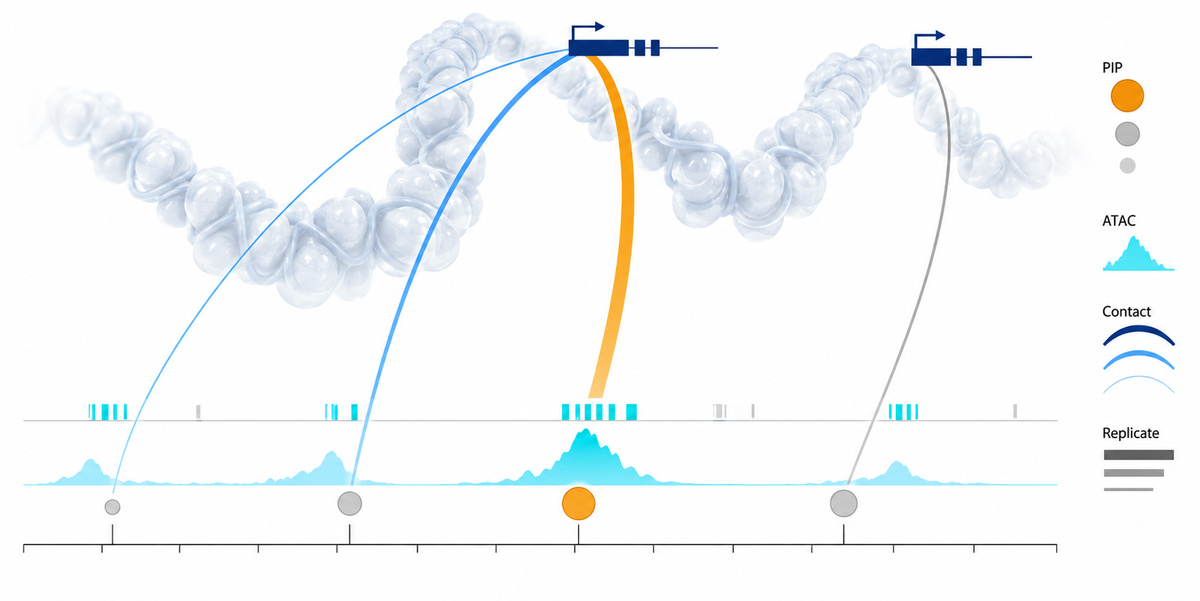 Figure 3: PIP-Weighted Variant-to-Promoter Contact Map. Candidate variants are ranked by posterior inclusion probability and regulatory context before promoter contacts are used to prioritize, rather than declare, effector-gene hypotheses.
Add Orthogonal Evidence Without Double-Counting It
Fine mapping, chromatin accessibility, promoter interaction, eQTL co-localization, expression, and functional annotations are complementary because they answer different questions. They become misleading when they are treated as independent confirmations despite being derived from the same samples, the same regulatory mark, or overlapping statistical assumptions. Build the evidence matrix so that each column states its source, cell context, directionality, and dependency on other columns.
For example, an accessible credible-set variant and an H3K27ac signal are useful regulatory observations, but they should not be counted as two fully independent votes if both merely reflect the same active enhancer. In contrast, a replicated promoter contact, a co-localized expression QTL, and a perturbation-induced expression change form more distinct evidence layers. This is where a multi-omics service can be planned around a single decision matrix rather than as a collection of disconnected assays.
Use expression QTLs carefully. Co-localization can support a shared genetic signal, yet it does not establish that the QTL gene alone mediates disease risk, and the relevant eQTL may be absent from a bulk dataset. The most useful result is a context-matched pattern: a credible-set variant in an accessible regulatory element, a reproducible contact to an expressed promoter, and a molecular association whose direction is compatible with the functional experiment. For teams new to this integration, integrating eQTL analysis with GWAS is a useful companion resource.
Functional Validation Should Test the Proposed Mechanism
A functional experiment should challenge the exact claim produced by the evidence matrix. If the hypothesis is that a distal element modulates gene X in activated T cells, deleting gene X alone does not test the element-to-promoter mechanism. Consider complementary tests: perturb the candidate element, edit or disrupt the candidate allele where feasible, measure target-gene response in the relevant state, and assess a downstream molecular phenotype selected before the experiment.
Targeted CRISPR sequencing is useful for checking edit identity and locus-level outcomes. When the question is to prioritize multiple regulatory elements or genes, CRISPR screen sequencing can support a more scalable discovery design. In either case, include non-targeting controls, independent guides, edit-efficiency measurements, donor or biological replication, and a readout timing chosen for the expected regulatory effect.
Reporter assays can be helpful for asking whether an allele-bearing sequence has context-limited regulatory activity, but they remove the native chromatin and 3D context. They are therefore best used as supportive evidence, not as a substitute for endogenous perturbation. A strong validation plan makes this hierarchy visible: discovery evidence narrows the hypothesis; endogenous perturbation tests the locus mechanism; targeted phenotyping tests the biological consequence.
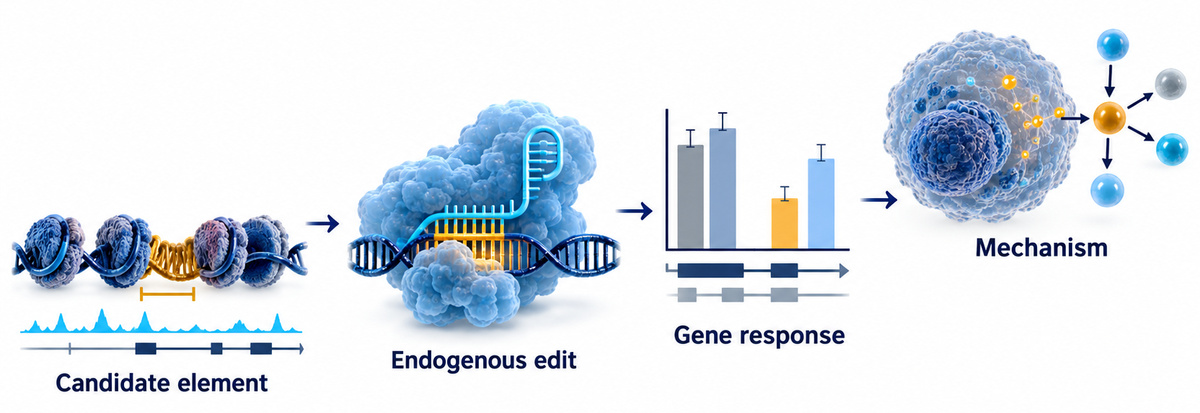 Figure 4: Functional Validation Ladder for a GWAS Effector-Gene Hypothesis. Functional work should progress from candidate-element perturbation to target-gene response and then to a preselected molecular phenotype in the relevant immune-cell context.
Build an Evidence Matrix That a Project Team Can Audit
A good evidence matrix prevents the final report from becoming an unranked list of nearby genes. One row should represent one variant–element–promoter–gene hypothesis. Columns should include locus identifier; credible-set membership and PIP; LD and ancestry source; cell type and state; accessibility and regulatory-mark overlap; contact assay, replicate support, and contact strength; QTL evidence; expression; functional evidence; conflicts; and the recommended next experiment.
Separate observations from conclusions. "A contact is reproducible in two stimulated donor replicates" is an observation. "Gene X is the most defensible current effector-gene hypothesis" is a conclusion that should name the evidence threshold behind it. This distinction is particularly important when several promoters contact the same regulatory region, when candidate genes are co-expressed, or when an eQTL is only observed in a neighboring state.
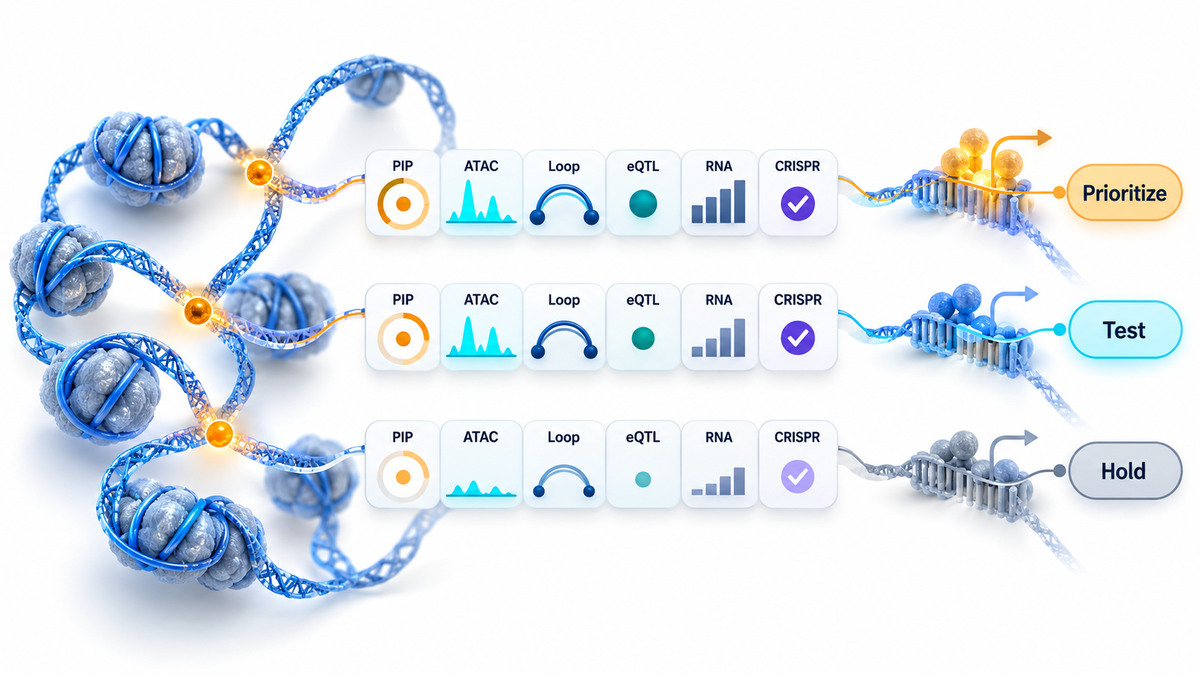 Figure 5: Auditable Evidence Matrix for Effector-Gene Prioritization. An evidence matrix keeps fine-mapping, regulatory, contact, expression, and perturbation findings separate so that confidence and uncertainty remain visible for each candidate hypothesis.
An End-to-End Workflow for Immune-Disease Loci
- Frame the use case. Specify the trait, population, locus count, decision to be made, and the required evidence level for a candidate gene to move forward.
- Prepare the statistical input. Harmonize summary statistics, LD, genome build, and credible sets; identify multiple independent signals before defining capture regions.
- Select the biological state. Use prior genetics, accessibility, and expression knowledge to nominate immune cell populations and stimulation conditions; state which alternatives remain untested.
- Generate fit-for-purpose regulatory and contact data. Match Hi-C, capture, or protein-anchored interaction assays to the question; include replicate and QC gates in the experimental plan.
- Integrate without collapsing evidence. Score variant–element–promoter–gene hypotheses while retaining data provenance and dependencies.
- Validate the highest-value uncertainty. Use targeted perturbation to decide whether a candidate element controls the predicted gene in the relevant state.
This workflow may combine public data with newly generated datasets. If a locus requires additional sequence resolution or matched discovery datasets, whole genome sequencing and whole exome sequencing can support different parts of a study, but neither should be positioned as a replacement for targeted regulatory evidence. The design question is always which dataset will reduce the next decision-relevant uncertainty.
Plan the Analysis Before Generating the Contact Map
The most efficient locus-to-gene studies make their analysis plan visible before libraries are generated. Predefine the unit of analysis: individual credible-set variant, variant cluster, accessible element, promoter fragment, or gene. Then predefine the decision rule for escalation. One example is to advance an element–gene pair only if the interval contains a high-priority candidate variant, overlaps a state-matched regulatory feature, has reproducible promoter-contact support, and has at least one nonredundant expression or functional line of evidence. The exact threshold can differ by project, but it should not be improvised after seeing the data.
Pre-specify how background will be handled. A promoter may have many contacts simply because it is highly active, highly expressed, or located in a contact-dense region. Compare a locus not only to all genomic contacts, but also to matched promoters or regions with similar accessibility, distance distribution, and mappability. Similarly, use permutation or matched-null strategies to ask whether credible-set variants are enriched at contacts more than expected for comparable variants. This helps avoid promoting a visually prominent arc that is no more notable than the local chromatin background.
Decide how evidence conflicts will be displayed. A gene may show a strong promoter contact but no detectable expression in the sampled state. An eQTL may point in the opposite direction to a perturbation. A credible-set variant may be accessible in one donor but not another. None of these outcomes need to be hidden. Mark them as conflicts, distinguish missing data from negative evidence, and state whether the discrepancy changes the next experiment. A report that preserves uncertainty is more useful for experimental planning than one that forces every locus into a single gene label.
Use sensitivity analyses to protect the ranking
Rankings can be sensitive to assumptions that are rarely visible in a final figure: credible-set threshold, PIP cutoff, contact-calling threshold, promoter annotation, genomic bin size, or whether a gene must be expressed above a chosen level. Re-run the prioritization across a small set of defensible parameter choices. If one candidate remains near the top across those choices, confidence rises. If its rank changes sharply, the correct conclusion is that the locus needs additional information, not that the highest score from one parameter set should be treated as decisive.
This is also where data integration benefits from a clear provenance model. Each matrix value should point back to a raw or processed source file, the software version, the biological state, and the applied threshold. That record allows analysts to update a locus when a better fine-mapping dataset or a more relevant immune-cell map becomes available without rebuilding the entire rationale manually.
Handle Multi-Gene and Multi-Variant Loci Explicitly
Some of the most informative loci are also the least tidy. One credible set may touch several accessible elements; one element may contact multiple promoters; or multiple independent association signals may occupy the same chromatin neighborhood. Treating this as a failure of the analysis loses biological information. The task is to determine whether the evidence supports one mechanism, several separable mechanisms, or an unresolved shared regulatory domain.
For a multi-gene locus, create distinct hypotheses rather than a collective label such as "the locus regulates genes A, B, and C." Each hypothesis should specify the candidate element, promoter, state, and expected direction of effect. A targeted perturbation can then be designed to discriminate among alternatives. If editing an enhancer changes more than one nearby transcript, the result may indicate a shared regulatory element or a secondary response; follow-up should measure timing and directness rather than immediately choosing the largest fold change as the true effector.
For a locus with multiple independent signals, do not merge all variants into one contact score. Retain signal membership throughout the analysis, because the same locus can contain distinct variant–gene mechanisms in the same or different immune states. This preserves a practical distinction between "one locus with several hypotheses" and "one broad hypothesis with many supporting markers."
Common Failure Modes
- Nearest-gene bias: Nearby genes are reported without checking credible-set overlap, cell-state activity, or promoter contacts.
- Cell-context mismatch: Contacts are generated in convenient cells rather than the most relevant lineage or activation state.
- Unweighted LD: Every linked SNP is interpreted equally, obscuring high-PIP candidates.
- Technical contact interpreted as causal: A loop is treated as proof without expression or perturbation evidence.
- Evidence duplication: Several measurements of the same enhancer state are counted as independent confirmation.
- Validation mismatch: A gene knockout is used to claim validation of a variant-to-enhancer-to-promoter mechanism.
What the Final Evidence Package Should Contain
The final deliverable should be usable by bioinformaticians, experimental scientists, and project leads without asking each group to reconstruct the analysis. Include a locus summary, credible-set table, cell-state rationale, assay and QC report, contact map, evidence matrix, negative or conflicting observations, and a prioritized validation plan. Record the version of every reference dataset and analytical threshold. That traceability is what turns a compelling visualization into a reproducible research asset.
For broader context on combining association and functional-genomics evidence, see advanced topics and innovations in GWAS. The goal of a promoter-interaction study is not to produce the most elaborate contact map; it is to make the next variant-to-gene experiment more discriminating.
Frequently Asked Questions
Does a promoter contact prove that a GWAS variant regulates that gene?
No. It supports a candidate link in the measured context. Fine mapping, regulatory evidence, expression evidence, and endogenous perturbation are needed to make the hypothesis more defensible.
When is promoter capture preferable to genome-wide Hi-C?
Use promoter capture when the decision centers on promoter contacts at defined loci and increased promoter-focused sensitivity is more useful than an all-by-all architecture map.
Can public eQTL data replace expression profiling in the planned cell state?
No. Public eQTLs are valuable supporting evidence, but their tissue, donor composition, stimulation condition, and statistical power may not match the experiment.
How many candidate genes should proceed to functional validation?
Choose a number that the evidence and perturbation design can discriminate. It is better to test a short ranked set with meaningful controls than to label every contacted promoter as a validated target.
Can an enhancer contact more than one promoter?
Yes. One regulatory region can contact multiple promoters, and one promoter can integrate multiple distal inputs. The evidence matrix should preserve this many-to-many structure.
What is the most important pre-analysis decision?
Selecting the relevant cell type and state. A technically strong contact map from the wrong biological context may be less useful than a narrower map from the right one.
References:
- Martin P, et al. Chromosome contacts in activated T cells identify autoimmune disease candidate genes. Genome Biology. 2017;18:165. DOI: 10.1186/s13059-017-1285-0.
- Mifsud B, et al. Capture Hi-C reveals novel candidate genes and complex long-range interactions with related autoimmune risk loci. Nature Communications. 2015;6:10069. DOI: 10.1038/ncomms10069.
- Alda-Catalinas C, et al. Mapping the functional impact of non-coding regulatory elements in primary T cells through single-cell CRISPR screens. Genome Biology. 2024;25:42. DOI: 10.1186/s13059-024-03176-z.
- Zhong X, et al. Integration of functional genomics and statistical fine-mapping systematically characterizes adult-onset and childhood-onset asthma genetic associations. Genome Medicine. 2025;17:35. DOI: 10.1186/s13073-025-01459-z.
- Trang KB, et al. 3D chromatin-based variant-to-gene maps across 57 human cell types reveal the cellular and genetic architecture of autoimmune disease susceptibility. Genome Biology. 2025;26. DOI: 10.1186/s13059-025-03880-4.
Related Services
- Genome-wide Association Study (GWAS)
- SNP Fine Mapping
- Hi-C Sequencing
- ATAC-Seq
- RNA-Seq
- ChIP-Seq
- CRISPR Screen Sequencing
- CRISPR Sequencing
- Multi-Omics Service
Research Use Only. Not for use in diagnostic procedures, clinical decision-making, patient stratification, therapeutic selection, or clinical trials.