x


DNA fragment analysis is a cornerstone of the life sciences, revealing genetic variation with meaningful research and clinical impact. Capillary electrophoresis (CE) is the gold standard for this work, delivering exceptional resolution, sensitivity, and reproducibility. Our CE-based workflows provide accurate sizing and relative quantification of DNA fragments from tens to hundreds of base pairs.
Request a QuotePrecision Genotyping for Animal/Plant Genetics
The CE Panel for Agriculture is a comprehensive genotyping platform based on capillary electrophoresis (CE) technology, supporting both STR (Short Tandem Repeat) and SNP (Single Nucleotide Polymorphism) markers. Utilizing fluorescent PCR-CE, this solution enables accurate and efficient detection for individual identification, parentage verification, and genotyping of economically important traits in both plants and animals. It is designed to support breeding optimization, genetic resource management, and market standardization efforts.

High-Resolution Solutions for Genetic Disease Diagnosis
Capillary electrophoresis (CE) genetic testing combines fluorescent PCR with CE to sensitively detect repeat expansions, copy-number variants, and other subtle alterations that conventional methods may miss. It enables accurate, early diagnosis of inherited disorders such as Fragile X syndrome and spinal muscular atrophy—supporting clinical decisions and long-term care. CE-based assays offer high specificity, reproducibility, and resolution for routine diagnostics and advanced screening.

The era of precision oncology emphasizes treatment strategies tailored to the genetic features of each tumor. Molecular profiling enables researchers to explore genetic mutations, microsatellite instability (MSI), and pharmacogenomic markers associated with tumor behavior and drug response. These insights lay the foundation for developing targeted therapies and improving patient outcomes.

STR CE Panels Empowering Human Identification
Short Tandem Repeat (STR) analysis is a cornerstone of forensic DNA profiling, extensively applied in criminal investigations, paternity assessments, and national DNA databases. By targeting specific repetitive DNA regions, STR typing provides exceptional resolution for identifying individuals, determining familial relationships, and studying population genetics. Achieving high levels of accuracy, consistency, and global database compatibility necessitates the use of a precise, high-resolution detection method—Capillary Electrophoresis (CE).

Power your CE fragment analysis with an end-to-end workflow designed for accuracy and speed.

Cell Line Authentication
Misidentified cell lines lead to misleading data, experimental confusion, and unnecessary costs. In response, many leading journals and funding bodies now require cell line authentication. Short tandem repeat (STR) profiling by capillary electrophoresis (CE) generates a distinctive, reproducible genetic fingerprint for rapid, cost-effective identity verification.
Microsatellite Marker Analysis
Microsatellites are short, repetitive DNA sequences (typically 2–6 bp per repeat unit) with high polymorphism and codominant inheritance. While the repeat motif is constant at a given locus, the number of repeats—and thus amplicon size—varies among individuals. CE resolves these size differences with single-base precision, making microsatellites ideal for applications such as microsatellite instability (MSI) testing in oncology and genetic disease studies.
QF-PCR
Quantitative fluorescent PCR (QF-PCR) enables accurate relative quantification of DNA fragments by comparing fluorescent peak heights or areas across loci and samples. It is widely used for loss of heterozygosity (LOH) assessment, aneuploidy detection in prenatal diagnostics, and characterization of chromosomal abnormalities.
MLPA
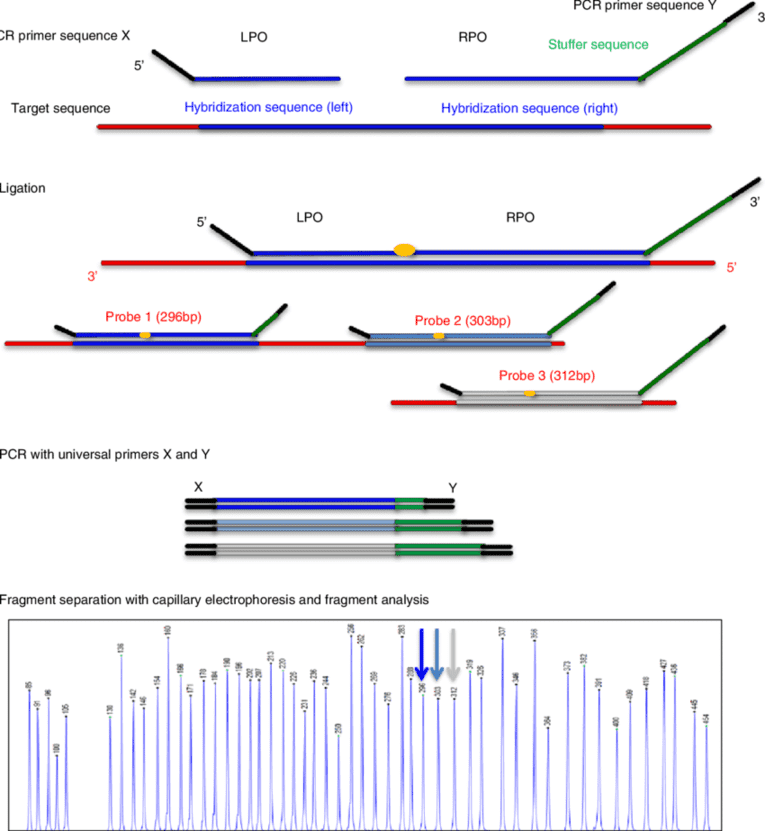
Multiplex ligation-dependent probe amplification (MLPA), developed by MRC-Holland, is a highly multiplexed, cost-effective method for detecting copy-number variation across up to 50 genomic loci in a single reaction. It is extensively validated for diagnosing hereditary disorders and profiling copy-number changes in cancer.
SNP Genotyping
Single-nucleotide polymorphism (SNP) genotyping identifies variants associated with disease risk, phenotypic traits, and drug response. The CD Genomics Multiplex System supports multiplexed single-base extension for up to 10 SNPs per reaction, with clear allele resolution by CE.
Gene Editing Analysis
CRISPR-Cas9 genome editing has transformed functional genomics through its precision and programmability but editing efficiency and repair outcomes are often heterogeneous. CE-based fragment analysis provides rapid, quantitative assessment of insertion/deletion (indel) profiles and overall editing efficiency in transfected cell populations.
Please submit a detailed description of your project. We will provide you with a customized project plan to meet your research requests. You can also send emails directly to for inquiries.
Please fill out the form below: ×