

Low-Coverage WGS
LcWGS is a technology based on Next-generation sequencing (NGS) technology, with a sequencing depth of less than 10X (generally 0.5X-6X in real application scenarios), to sequence the entire DNA sequences of individual genomes of existing reference genomes and to analyze the variability of individuals or groups. Compared with conventional WGS technology, LcWGS only adds an extra step of genotype filling in the analysis, but it can realize the identification and typing of genome-wide genetic variants at a lower sequencing depth and cost than conventional WGS.
Based on our next-generation sequencing platform, CD Genomics has developed a full set of LcWGS and low-coverage resequencing analysis processes for agricultural plants and animals, providing GWAS, genetic structure analysis of economically important traits, and a theoretical basis for researching new genetic analysis methods and breeding.
You can refer to our Genotyping By Sequencing (GBS) platforms for more information.
Features of LcWGS Service
- Reference-Driven Precision
Refined resolution using haplotype data from leading reference genomes like 1KGP or HRC.
LC-WGS adapts beyond fixed genotyping arrays, allowing successful GWAS studies with coverage as low as 1.5x. - Universal Applicability
Versatile across diverse species, from animals to crops and aquaculture.
Actively integrating LC-WGS or resequencing into plant and animal breeding for broader applications. - Smart Hybrid Sequencing
Efficient genotype imputation by combining low-coverage resequencing with high-coverage sequencing for key individuals.
Unlocks advantages for breeding support and economic trait analysis. - Streamlined Operations
Easy operation with high-throughput commercial solutions for library prep and data analysis.
Simplifies LC-WGS for accessibility and efficiency. - Comprehensive Genome Utilization
Leverage every genomic site for trait selection and SNP/CNV discovery. - Statistical Power Boost
Outperforms microarray methods in whole-genome association analysis.
Enhances the ability to uncover complex genetic relationships. - Continuous Discovery
Growing database increases potential for new variations.
Allows for reanalysis of existing data to keep insights up-to-date.
How to choose LcWGS, WGS, GBS and Microarrays?
When selecting between LC-WGS, WGS, GBS, and Microarrays, consider the following factors:
| Technology | Initial Investment | Operational Cost | Flexibility | Operational Complexity | Reference Required | Discovery Potential |
|---|---|---|---|---|---|---|
| WGS (Whole Genome Sequencing) | None | Poor | Good | Good | Good | Good |
| GBS (Genotyping-by-Sequencing) | Poor | Good | Fair | Good | Poor | Fair |
| Low Coverage Sequencing | None | Good | Good | Good | Fair | Good |
| Microarrays | Poor | Good | Fair | Good | Poor | Poor |
Select the technology aligned with your research goals, budget constraints, and the level of genomic detail required. If you have more questions, please contact our technique team.
Samples requirements
| Sample type | Genomic DNA |
| Sample concentration | ≥ 20 ng/μL |
| Total sample | ≥ 500 μg |
| Sample purity | OD260/280 for 1.8-2.2 |
| Electrophoresis requirements | Clear main band, no degradation or mild degradation |
| Deliverables | Raw data QC, FASTQ, BAM and VCF, etc. |
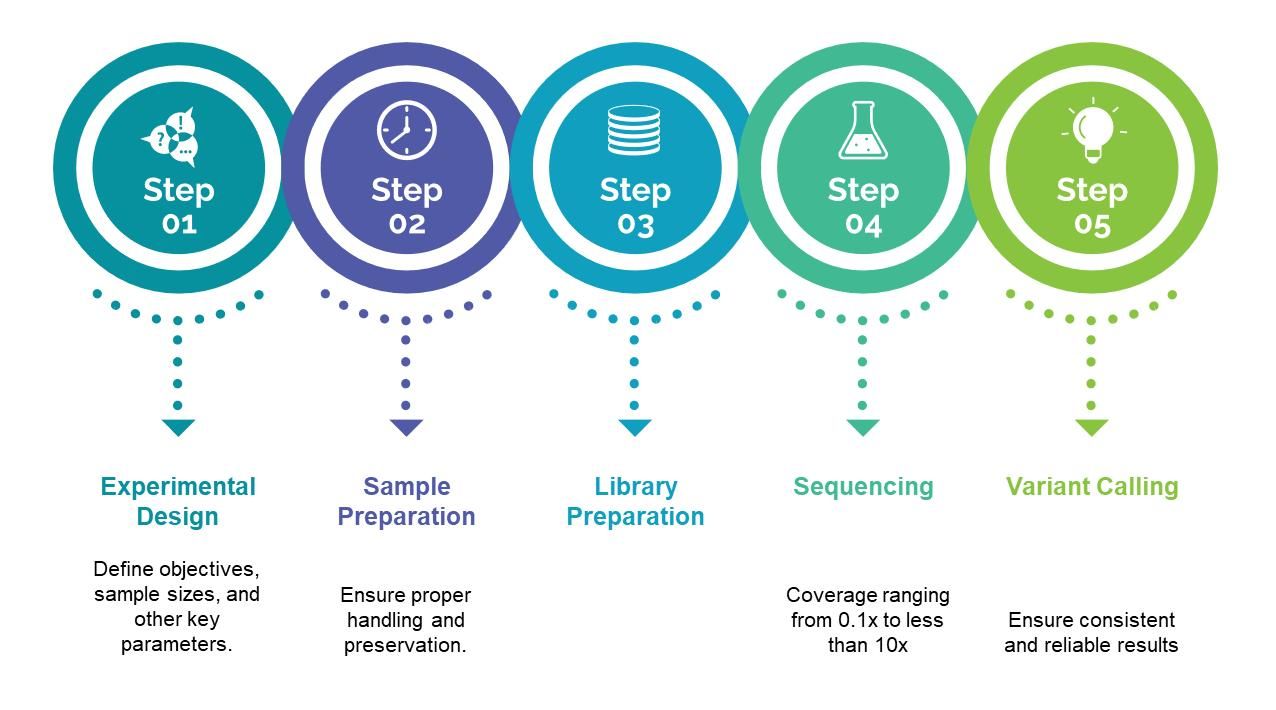
Service workflow
Applications
1. Genome-Wide Association Studies (GWAS)
Uncover the genetic basis of complex traits and diseases through our LC-WGS, enabling robust GWAS for a deeper understanding of the underlying genomic architecture.
2. Key Trait Genetic Structure Analysis
Gain insights into the genetic foundations of economically significant traits in agricultural plants and animals, facilitating informed breeding strategies.
Explore the intricate dynamics of population genetics, enabling comprehensive studies on diversity, migration, and adaptation.
4. Novel Genetic Analysis Methods
Pioneer research in innovative genetic analysis methods, leveraging the extensive data provided by LC-WGS to push the boundaries of genetic exploration.
Provide a theoretical framework for advanced breeding practices by understanding the genetic landscape and variability within a population.
 Send a Message
For any general inquiries, please fill out the form below.