

Whole Genome Bisulfite Sequencing (WGBS) Service
Unlock the epigenome with our Whole Genome Bisulfite Sequencing (WGBS) service, the gold standard for single-base resolution DNA methylation profiling. From complex plant genomes to mammalian multi-omics, we deliver >99% conversion efficiency and publication-ready bioinformatics, helping you seamlessly map differentially methylated regions (DMRs) with absolute precision.
Key Highlights of Our WGBS Service:
- Gold Standard: True single-base resolution across the entire genome.
- High Efficiency: Rigorous bisulfite conversion rates consistently exceeding 99%.
- Broad Compatibility: Proven wet-lab success in human, animal, and recalcitrant plant samples.
- Advanced Bioinfo: Seamless multi-omics integration and custom, publication-ready visualizations.
The Gold Standard Principle: How WGBS Works
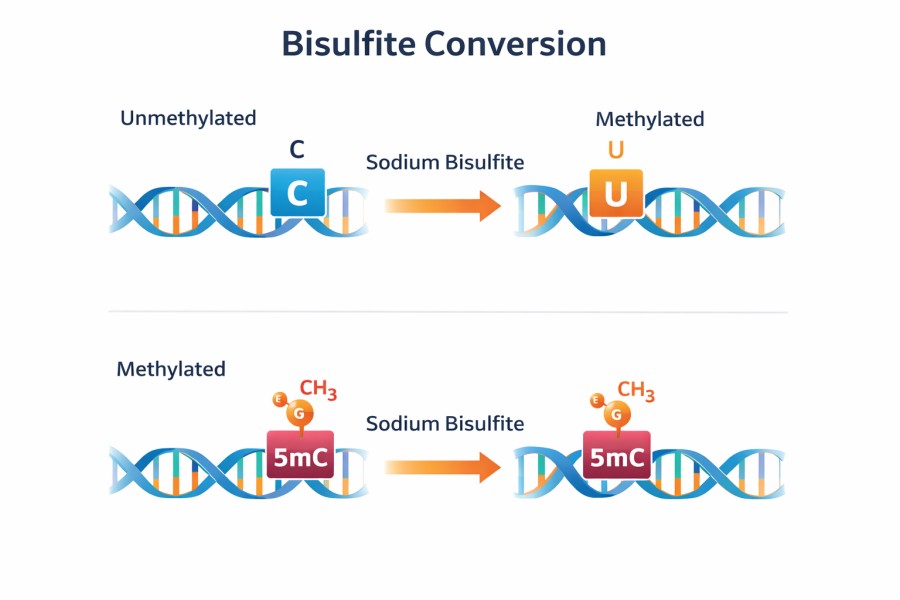
The core principle of WGBS relies on the highly specific chemical treatment of DNA using sodium bisulfite. During this treatment, unmethylated cytosines (C) are deaminated and converted into uracils (U), which are subsequently read as thymines (T) during PCR amplification and sequencing. Crucially, methylated cytosines (5mC) are protected from this chemical reaction and remain as cytosines (C). By comparing the sequenced reads against a reference genome, our pipeline accurately determines the methylation status of every single cytosine at single-nucleotide resolution, providing an unbiased, comprehensive map of the epigenome.
Technology Decision Guide: WGBS vs. EM-seq vs. 5-base
Selecting the right methylation technology depends on your sample quality, DNA input amount, and specific research goals.
| Feature | WGBS (Gold Standard) | EM-seq (Enzymatic) | 5-base (Dual-Omics) |
|---|---|---|---|
| Conversion Principle | Chemical (Sodium Bisulfite) | Enzymatic Conversion | Chemical (Converts 5mC only) |
| GC Bias | High GC bias | Imbalanced | Relatively Balanced |
| Data Output | 5mC profiles | 5mC profiles | 5mC + SNV, Indel, CNV, SV |
| Minimum DNA Input | gDNA ≥ 2 µg | gDNA ≥ 300 ng (cfDNA ≥ 10 ng) | gDNA ≥ 200 ng (cfDNA ≥ 20 ng) |
Selection Strategy:
- Choose WGBS if you have abundant, high-quality DNA (≥ 2 µg) and require the traditional, heavily validated gold standard for basic research and comprehensive epigenome mapping.
- Choose EM-seq if your samples are precious, highly degraded (like FFPE), or ultra-low input (like cfDNA). EM-seq utilizes a gentler enzymatic conversion that minimizes DNA damage. Explore our Enzymatic Methylation Sequencing (EM-seq) service for these challenging samples.
- Choose 5-base if you need simultaneous dual-omics data (both genetic variants and methylation patterns) from a single high-throughput sequencing run.
Applications in Epigenetics Research
WGBS provides the highest resolution of DNA methylation, empowering researchers across diverse fields to uncover deep epigenetic mechanisms.
Map dynamic DNA methylation reprogramming during embryogenesis, cell lineage commitment, organogenesis, and aging processes.
Identify aberrant hypermethylation of tumor suppressor promoters or global hypomethylation to discover novel epigenetic biomarkers (for research use only).
Investigate epigenetic responses to environmental stress (e.g., heat, drought) and the precise regulation of agronomically important traits in complex crops.
Correlate promoter methylation states directly with gene expression profiles by integrating WGBS data with RNA-Seq or ATAC-Seq chromatin accessibility data.
End-to-End Service Workflow & QC Checkpoints
Because bisulfite treatment can cause DNA fragmentation, we have optimized our workflow to maximize library complexity and data yield. Our process incorporates strict quality control (QC) milestones to ensure your samples are safe and the conversion is highly efficient.
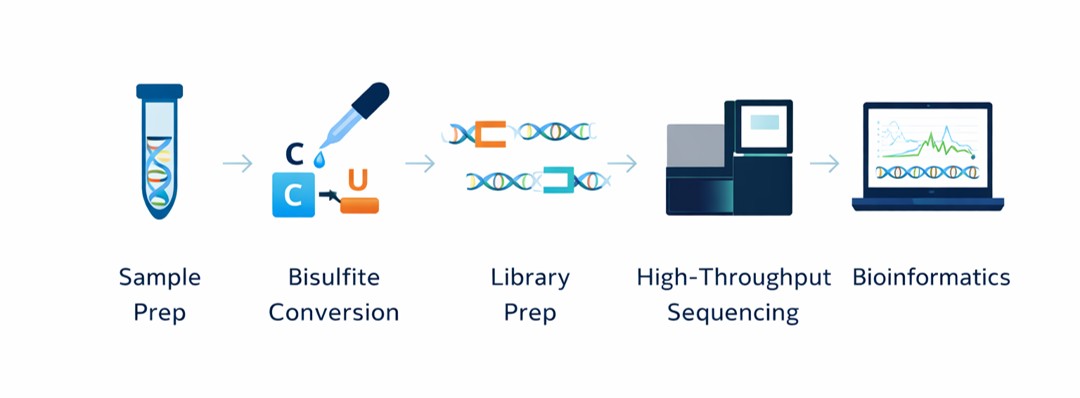
- Step 1: Sample Preparation & Initial QC: We assess DNA integrity, purity, and concentration using advanced fluorometric quantification. Only samples passing strict thresholds proceed, protecting your research investment.
- Step 2: Bisulfite Conversion & QC: We apply optimized chemical protocols to minimize DNA degradation while ensuring complete conversion. QC Milestone: We guarantee a bisulfite conversion rate of >99%, minimizing false positives in your methylation data.
- Step 3: Library Construction & QC: Converted DNA is fragmented and ligated with sequencing adapters. QC Milestone: Libraries are rigorously checked for optimal fragment size distribution and concentration before sequencing.
- Step 4: High-Throughput Sequencing: Qualified libraries undergo paired-end sequencing (PE150) on industry-leading platforms to generate massive, high-quality data outputs.
- Step 5: Bioinformatics & Data Delivery: Raw reads are filtered, aligned to the reference genome, and processed through our specialized epigenetic pipelines to extract meaningful biological insights.
Comprehensive Bioinformatics & Multi-Omics Pipeline
Handling massive WGBS datasets requires immense computational power and deep epigenetic expertise. We do not just hand you raw data; we provide a "reviewer-proof" analytical pipeline categorized to meet both foundational and advanced research needs.
Standard Epigenomic Profiling:
- Raw data QC, filtering, and precision reference genome alignment.
- Sequencing depth and genome-wide coverage distribution analysis.
- Single-base methylation level calculations across all sequence contexts (CpG, CHG, CHH).
- Identification, annotation, and length distribution of Differentially Methylated Regions (DMRs).
- Gene Ontology (GO) biological processes and KEGG pathway enrichment for DMR-associated genes.
Advanced Multi-Omics & Custom Analysis:
- Multi-Omics Integration: We can seamlessly integrate your WGBS data with transcriptomics or our ATAC-Seq Service to directly correlate promoter methylation states with chromatin accessibility and downstream gene expression.
- Specialized Profiling: Deep dives into imprinted gene regulation, transposable element (TE) silencing, and allele-specific methylation (ASM).
- Publication-Ready Custom Visualizations: Generation of high-resolution Circos plots, Manhattan plots for chromosomal DMR distribution, and complex hierarchical clustering heatmaps.
Publication-Ready Demo Results
Our deliverables are designed for direct inclusion in top-tier journals. We provide a comprehensive suite of visualizations that not only show your data clearly but actively prove your mechanistic hypotheses.
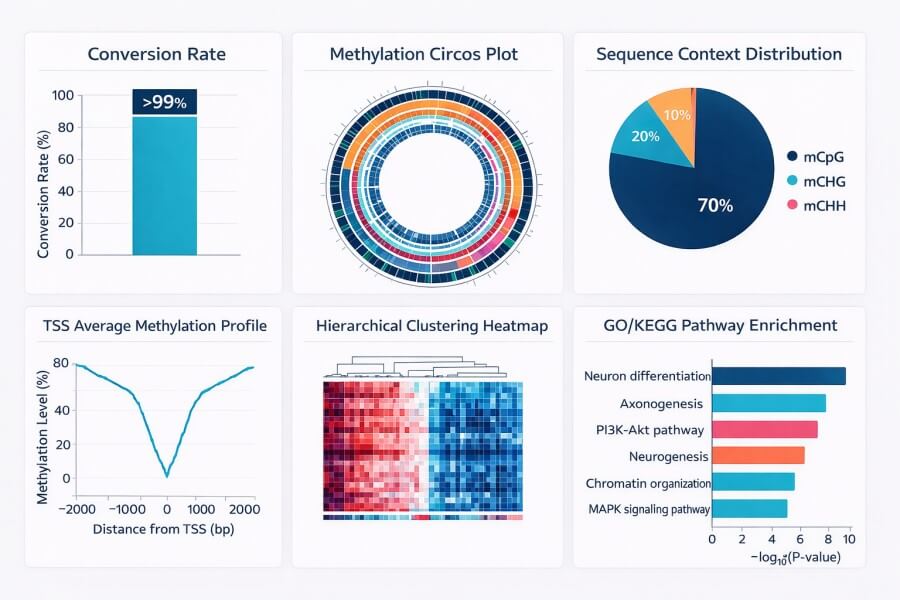
- Bisulfite Conversion Rate QC: A precise bar chart confirming >99% conversion efficiency, proving the technical reliability and accuracy of the sequencing library.
- Global Methylation Circos Plot: A circular visualization of chromosomal methylation levels, validating genome-wide distribution patterns to support your claims of global epigenetic shifts.
- Sequence Context Distribution: A clean pie chart showing the exact ratios of mCpG, mCHG, and mCHH, characterizing the specific methylation landscape of your target species (especially vital for plant research).
- TSS Average Methylation Profile: A high-resolution line graph showing sharp methylation drops precisely at active Transcription Start Sites, validating the inverse relationship between promoter hypermethylation and gene accessibility.
- DMR Hierarchical Clustering Heatmap: A color-coded statistical matrix visually separating methylated regions between control and treated groups, instantly identifying and proving robust epigenetic biomarker candidates.
- GO/KEGG Enrichment Bar Charts: Clear bar graphs detailing the functional annotation of DMR-associated genes, translating raw methylation percentages into biologically actionable and proven regulatory pathways.
Strict Sample Requirements & Handling Guidelines
Because bisulfite conversion fragments DNA, adherence to strict sample quality guidelines is the most critical factor for project success.
| Sample Type | Minimum Input Requirement | Quality & Condition Requirements | Important Notes |
|---|---|---|---|
| Genomic DNA | ≥ 2 µg | Concentration ≥ 20 ng/µL | Must be highly pure (RNA/protein-free). Freshly extracted DNA is strongly recommended. |
| Fresh Frozen Tissue | 10 – 30 mg | Snap-frozen in liquid nitrogen | Wash with saline. DO NOT store in RNAlater, TRIzol, or ethanol. |
| Cultured Cells | ≥ 2×10^6 cells | Washed with PBS and pelleted | Snap-freeze immediately and store at -80°C. |
| Plant Tissue | ≥ 300 mg | Young leaves / nucleic-acid rich parts | For plants high in polyphenols/polysaccharides, please extract DNA prior to shipping. |
| cfDNA / FFPE | Not Recommended | Severe degradation risk limits WGBS success | Please utilize our EM-seq service for these specific sample types. |
Case Studies: Empowering Global Epigenetic Research
Frequently Asked Questions (FAQ)
References
- Eileen, L., & Peterson, M. (2024). High-Fat Diets Fed during Pregnancy Cause Changes to Pancreatic Tissue DNA Methylation and Protein Expression in the Offspring: A Multi-Omics Approach. International Journal of Molecular Sciences, 25(13), 7317.
- Feyissa, B. A., et al. (2025). Species-Specific Epigenetic Signature Associates With Heat Stress Tolerance in the Perennial Tree Species Populus. GCB Bioenergy, 17, e70033.
- Wang, X., et al. (2024). Comprehensive analysis of DNA methylation in human placenta reveals unique epigenetic signatures. PLoS Genetics, 20(5), e1011742.